
KAMDA SILAPEUX ARISTIDE GUILLAUME1,*, BOLDA ESTHER MARALOSSOU1, TIENTCHEU BERNARD2 and PONKA ROGER3.
1 Department of Social Economy and Family Management, University of Buea, P.O Box 249, Buea Road, Kumba, Cameroon
2 Department of Biochemistry and Molecular Biology, Faculty of Science, University of Buea, P.O BOX 63, Buea, Cameroon
3 Department of Agriculture, Livestock and Derived Products, National Advanced School of Engineering of Maroua, University of Maroua, P.O. Box 48, Maroua, Cameroon
*Corresponding author: silapeuxkamda@gmail.com
Received: 07 Sep 2025, Reviewed: 06 Nov 2025, Revised: 17 Nov 2025, Accepted: 15 Dec 2025, Published: 30 March 2026.
https://doi.org/10.63342/cjbbs2026.34.25-O28.en
ABSTRACT
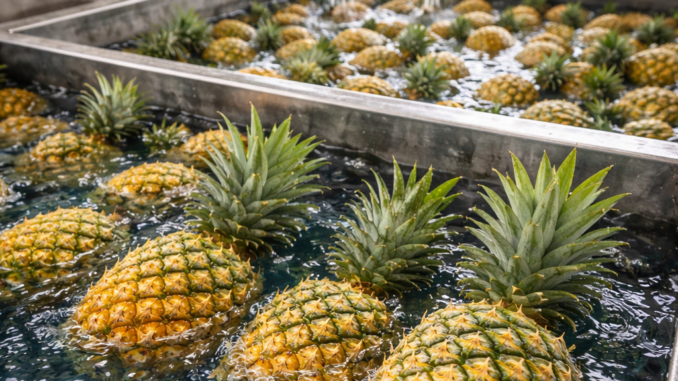
Post-harvest loss of fruits, particularly pineapples are a matter of concern for countries with agriculture-based economies. Therefore, developing and implementing treatment methods to extend the shelf life of pineapples by reducing post-harvest decay and maintaining the physicochemical qualities of the fruit is of prime importance. We aimed to investigate the effects of different post-harvest treatment methods on changes in the physico-chemical and sensory properties of pineapple fruits during storage at room temperature. The experiment comprised three post-harvest treatments: Control (Untreated samples), NaCl solution (immersion in a 10% NaCl solution for 3 min), Citric Acid solution (immersion in a 10 mmol/L citric acid solution for 3 min) and Hot water treatment (immersion in hot water at 54°C for 3 min). The fruits were evaluated for physiological weight loss, decay percentage, total soluble solids, titratable acidity, shelf life and ascorbic acid content every 2 days. Sensory analysis was performed on the 4th day post-treatment. The experiment followed a completely randomised design with three replications. There were significant differences between the control and treated samples. Pineapple fruits treated with hot water exhibited the lowest weight loss (9.2 %) and the lowest decay rate (11.11 %) after 14 days of storage at ambient temperature (25°C ± 3). The maximum shelf life (10.1 days) was observed in fruits treated with hot water, followed by those treated with citric acid (8 days). Although hot water treatment significantly reduced vitamin C content (25.32 mg/100 ml), its effects on sensory attributes were not significant. Principal Component Analysis indicated a positive correlation between NaCl treatment, no treatment, physiological weight loss, and fruit decay rate. Hot water treatment of fresh pineapple fruits can be applied on a large scale as it is low-cost and improves the product’s marketability.
Keywords: Pineapple, hot water treatment, citric acid, shelf life, Vitamin C, sensory properties.
RÉSUMÉ
Les pertes post-récoltes des fruits en général et de l’ananas en particulier sont une préoccupation pour tous les pays dont l’économie est basée sur l’agriculture. Il est impératif aujourd’hui de développer et de mettre en œuvre des méthodes de traitement pour améliorer la durée de conservation de l’ananas tout en maintenant ses propriétés physico-chimiques. L’objectif de cette étude était d’étudier les effets de différentes méthodes de traitement post-récolte sur les propriétés physico-chimiques et sensorielles des fruits d’ananas, conservés à température ambiante. La méthodologie a consisté à mettre en œuvre 3 traitements post-récolte: Immersion dans une solution de NaCl, 10 % pendant 3 min, immersion dans une solution d’acide citrique, 10 mmol/l pendant 3 min et immersion dans de l’eau chaude à 54 °C pendant 3 min. Une fois traités, les fruits ont été entreposés à température ambiante dans la chambre de séchage. Tous les 2 jours, 2 fruits ont été prélevés aléatoirement pour évaluer la perte physiologique de masse, le taux de pourriture, la totalité des particules solides solubles (STS), l’acidité titrable, la durée de conservation et la concentration en acide ascorbique. L’analyse sensorielle a été effectuée au 4e jour d’entreposage après le traitement. L’expérimentation a été réalisée selon un plan randomisé complet (CRD) avec trois réplications. Les résultats ont montré qu’il y avait une différence significative entre les échantillons témoins et traités. Les fruits d’ananas traités avec de l’eau chaude ont montré la plus faible perte de masse (9,2 %), le taux de pourriture le plus bas (11,11 %) après 14 jours d’entreposage à température ambiante (25 °C ± 3). La durée de conservation maximale (10,1 jours) a été observée dans le cas des fruits traités à l’eau chaude, suivie par les fruits traités avec de l’acide citrique (8 jours) par rapport au témoin (4,3 jours). Le traitement à l’eau chaude a réduit significativement la teneur en vitamine C (25,32 mg/100 ml), mais l’effet sur les attributs sensoriels n’était pas significatif. L’Analyse en Composantes Principales (ACP) a indiqué une corrélation positive entre le traitement au NaCl, le contrôle, la perte physiologique de masse et le pourcentage de décomposition des fruits. Le traitement à l’eau chaude des ananas frais doit être appliqué à grande échelle car il est facile à mettre en œuvre, et a moins d’impact négatif sur la qualité marchande du produit.
Mots-clés: Ananas, traitement à l’eau chaude, acide citrique, durée de conservation, Vitamine C, attributs sensoriels.
REFERENCES
Adisa V A (1986). The influence of moulds and some storage factors on the ascorbic content of orange and pineapple fruits. Food Chemistry 22, 139-146. https://doi.org/10.1016/0308-8146(86)90031-2
Agbo A E, Gnakri D, Beugre G M, Fondio L and Kouame C (2008). Maturity degree of four okra fruit varieties and their nutrients composition. Electronic Journal of Food and Plants Chemistry, 5:1-4.
AGROCOM (Agriculture, Agro-industrie, Communication) (2002). Guide de production et de protection de l’ananas. PDE-Cameroun. Les publications d’AGROCOM, 38p.
Ahmed J and Siddiq M (2016). Innovative processing technologies for pineapple processing. In María Gloria Lobo, and Robert E. Paull, Handbook of Pineapple Technology: Production, Postharvest Science, Processing and Nutrition, John Wiley & Sons, Ltd. https://doi.org/10.1002/9781118967355.ch10
Akangtula J and Chhungpuii K (2017). Effects of Different Post-harvest Treatments on Physico-Chemical Attributes and Shelf Life of Tomato Fruits. Science and Technology Journal. Vol. 5 Issue: I ISSN: 2321-3388
Amin M N and Hossain M M (2013). Development of a hot water treatment plant suitable for banana. Agricultural Engineering International: CIGR Journal, 15(4): manuscript No. 2658.
AOAC (2005). Official Methods of Analysis of AOAC International. AOAC International suite 500. 481 North Frederick Avenue. Gaithersburg, Maryland 20877-2417, USA.
AOAC (2000). Official methods 960.19, 962.12. In Official Methods of Analysis of AOAC International, 17th Ed., Vol. II pp. 70–75, AOAC, Gaithersburg, MD.
Asghari M. and Ashdam M S (2010). Impact of salicylic acid on post harvest physiology of horticultural crops. Trends in Food Science & Technology, 21: 502-509. https://doi.org/10.1016/J.TIFS.2010.07.009
Babalar M, Asghari M, Talaei A, and Khosroshahi A (2007). Effect of pre- and postharvest salicylic acid treatment on ethylene production, fungal decay and overall quality of Selva strawberry fruit. Food Chemistry, 105, 449e453. https://doi.org/10.1016/j.foodchem.2007.03.021
Baltazari A, Hosea D, Mtui M, Mwatawala W, Lucy M, Theodosy M, Jaspa S and Jayasankar S (2020). Effects of Storage Conditions, Storage Duration and Post-Harvest Treatments on Nutritional and Sensory Quality of Orange (Citrus sinensis (L) Osbeck) Fruits International Journal of Fruit Science, 20:4, 737-749. https://doi.org/10.1080/15538362.2019.1673278
Barrett B C (2007). “Smallholder Market Participation: Concepts and Evidence from Eastern and Southern Africa.” Prepared for FAO Workshop on Staple Food Trade and Market Policy Options for Promoting Development in Eastern and Southern Africa, Rome, March 1-2, 2007. Journal of Food Policy, 33: 299-317. https://doi.org/10.1080/23311932.2020.1783173
Basumatary I B, Mukherjee A, Katiyar V, Kumar S and Dutta J (2021). Chitosan-Based Antimicrobial Coating for Improving Postharvest Shelf Life of Pineapple. Coatings. 11, 1366. https://doi.org/10.3390/coatings11111366
Beaudry M C (1989). The Lowell Boott Mills complex and its housing: material expressions of corporate ideology. Historical Archaeology, 23(1): 19-32. FAO, 2020. Major Tropical Fruits Market Review 2019. Rome. 20 pp
Competitiveness Committee, Technical Secretariat. (2024). Report on the competitiveness status of Cameroon’s economy in 2023. Ministry of Economy, Planning, and Regional Development. 66 p.
Clarke R, Liu M, Bouker K, Gu Z, Lee R, Zhu Y, Skaar TC, Gomez B, O’Brien K, Wang Y and Hilakivi-Clarke L (2003). Antiestrogen resistance in breast cancer and the role of estrogen receptor signaling. Oncogene.;22:7316–7339. https://10.1038/sj.onc.1206937
Dhar M, Rahman S M, and Sayem S M (2008). Maturity and postharvest study of pineapple with quality and shelf-life under red soil. International Journal of Sustainability and Crop Production, 3(2) 69-75.
Elgar H J, Lallu N, and Watkins C B (1999). Harvest Date and Crop Load Effects on a Carbon Dioxide–related Storage Injury of Braeburn Apple. HortScience, 34(2): 305-309. https://10.21273/HORTSCI.34.2.305
FAO. 2023. Major Tropical Fruits Market Review – Preliminary results 2022. Rome.
FAOSTAT (Food and Agriculture Organization Corporate Statistical Database) (2021). 2019 Food and Agricultural Organization-statistical Database, Recorded Data for Pineapples Production Quantity in Benin. FAO (Food and Agriculture Organization of the United Nations), Rome. http://www.fao.org/faostat/en/#data/QC.
Feyera and Abdo J (2022). Post Harvest Treatments and Shelf Life of Some Tropical Fruit. Adv. Biol. Biotechnol., vol. 25, no. 9, pp. 48-55,; Article no. Journal of Advances in Biology & Biotechnology.91566. https://10.9734/jabb/2022/v25i9598
Gbenou B, Adjolohoun S, Houndjo D B M, Saïdou A, Ahoton L, Houinato M, Dahouda M and Sinsin A (2019). Difficulties to the Crops Forage Integration in Agricultural Farms in the Sudanian Area of Benin (West Africa). International Journal of Science and Research. Vol. 8 (5): 152-159). http://dx.doi.org/10.21474/IJAR01/9801
Ghafir S M M, Gadalla S O, Murajei M N, El-Nady M F (2009). Physiological and anatomical comparison between four different apple cultivars under cold-storage conditions. African Journal of Plant Science Vol. 3 (6), pp. 133-138.
Hajare S, Dhokane V, Shashidhar R, Saroj S D, Sharma A, and Bandekar J R (2006). Radiation processing of minimally processed pineapple (Ananas comosus Merr.): Effect on nutritional and sensory quality. Journal of Food Science, 71, 501–505. https://doi.org/10.1111/jfpp.13467
Jacobi K K, MacRae E A and Hetherington S E (2001). Postharvest heat disinfection treatments of mango fruit. Sciencia Horticulturae, 89 (3), 171-193. https://doi.org/10.1016/S0304-4238(00)00240-5
Jamir A and Chhungpuii K (2017). Effects of Different Post-harvest Treatments on Physico-Chemical Attributes and Shelf Life of Tomato Fruits. Science and Technology Journal, 5 (2) 2321-3388. https://doi.org/10.22232/Stj-2017-05-01-09
Jung S K and Watkins C (2008). Superficial scald control after delayed treatment of apple fruit with diphenylamine (DPA) and 1-methylcyclopropene (1-MCP). Postharvest Biology and Technology, 50 (1): 45–52. https://doi.org/10.1016/j.postharvbio.2008.05.006
Kabir M S N, Rasool K, Lee W H, Cho S I and Chung S O (2020). Influence of delayed cooling on the quality of tomatoes (Solanum lycopersicum L.) stored in a controlled chamber. AIMS Agriculture and Food, 5(2): 272–285. https://doi.org/10.3934/AGRFOOD.2020.2.272
Kader A and Rosa S R (2004). The role of post-harvest management in assuring the quality and safety of horticultural produce. FAO AGRICULTURAL SERVICES BULLETIN 152. FOOD AND AGRICULTURE ORGANIZATION OF THE UNITED NATIONS Rome, 52 p.
Kamda S A G, Ponka R, Frazzoli C, and Fokou E (2021). Waste of fresh fruits in Yaoundé, Cameroon: Challenges for retailers and impacts on consumer health. Agriculture, 11, 89. https://doi.org/10.3390/agriculture11020089
Kamiloglu O (2011). Influence of some cultural practices on yield, fruit quality and individual anthocyanins of table grape cv. ‘Horoz Karasi’. Journal of Animal and Plant Sciences, 21(2):240-245.
La Oge (2025). Postharvest Physiological Studies on the Quality and Shelf Life of Tropical Fruits: A Literature Review. JOURNAL OF AGRICULTURE, AGRIBUSINESS, WELFARE, TECHNOLOGY, HUMANITY, ENVIRONMENT, SOCIAL, AND ECONOMY. Volume 1 Nomor 1. E-ISSN: 3110-3495
Łata B (2007). Relationship between Apple Peel and the Whole Fruit Antioxidant Content: Year and Cultivar Variation. Journal of Agricultural and Food Chemistry, 55(3):663-71 https://doi.org/10.1021/jf062664j
Lawless H, and Heymann H (2010). Sensory evaluation of food science principles and practices. 2nd. Springer Science and Business Media Ithaca, New York. p. 596.
Li X, Zhu X, Zhao N, Fu D, Li J, Chen W (2013). Effects of hot water treatment on anthracnose disease in papaya fruit and its possible mechanism. Postharvest Biology and Technology, 86:437-46. https://doi.org/10.1016/j.postharvbio.2013.07.037
Lu X H, Sun D Q, Xi Y W M and Sun M (2010). Effect of postharvest salicylic acid treatment on fruit quality and antioxidant metabolism in pineapple during cold storage. The Journal of Horticultural Science and Biotechnology, 85: 454-458. https://doi.org/10.1080/14620316.2010.11512697
Lum M S and Norazira M A (2011). Effects of hot water, submergence time and storage duration on quality of dragon fruit (Hylocereus polyrhizus). Journal of Agricultural Science, 3(1), 146-152. https://doi.org/10.5539/jas.v3n1p146
Mandal D, Lalremruata T K, Hazarika and Nautiyal B P (2015). Effect of Post-harvest Treatments on Quality and Shelf Life of Pineapple (Ananas comosus [L.] Merr. ‘Giant Kew’) Fruits at Ambient Storage Condition. International Journal of Bio-resource and Stress Management, 6(4):490-496. https://doi.org/10.5958/0976-4038.2015.00072.X
Minh N P (2021). Influence of hot water treatment to quality properties of pineapple (Ananas comosus) fruit during storage. Food Research, 5 (5) : 186 – 194. https://doi.org/10.26656/fr.2017.5(5).470
Mondal M F (2000). Production and storage of fruits (in Bangla). Published by Mrs. Afia Mondal. BAU Campus, Mymensingh-2202. pp. 312.
Moskowitz H R and Krieger B (1995). The contribution of sensory liking to overall liking: An analysis of six food categories. Food Quality and Preference, 6(2):83–90. https://doi:10.1016/0950-3293(95)98552-T
Munhuweyi K, Mpai S and Sivakumar D (2020). Extension of avocado fruit postharvest quality using non-chemical treatments. Agronomy.;10(2):212. https://doi.org/10.3390/agronomy10020212
Ngo Bogmis M N, Newilah G N et Ndjouenkeu R (2016). Caractérisation des unités de séchage des ananas et qualités physicochimiques des produits alimentaires dérivés dans la région du Littoral Cameroun. International Journal of Biological and Chemical Sciences, 10(5): 2025-2038. http://ajol.info/index.php/ijbcs
Nyanjage M O, Wainwright H, and Bishop C F H (1998). The effects of hot-water treatments in combination with cooling and/or storage on the physiology and disease of mango fruits (Mangifera indica Linn.). The Journal of Horticultural Science and Biotechnology, 73:589–597. https://doi.org/10.1080/14620316.1998.11511019
Pardio-Sedas, V T, Waliszewski-Kubiak K N and Garcia-Alvarado M A (1994). Ascorbic acid loss and sensory changes in intermediate moisture pineapple during storage at 30–40°C. International Journal of Food Science & Technology, pp: 551. https://doi.org/10.1111/j.1365-2621.1994.tb02097
Pholoma S B, Emongor V and Tshwenyane S (2020). Physicochemical attributes in mango fruit (Mangifera indica) as influenced by storage temperature and hot water treatment. Journal of Experimental Agriculture International, 42(1), 133141. https://doi.org/10.9734/jeai/2020/v42i130459
Prusky D, Fuchs Y, Kobiler I, Roth I, Weksler A, Shalom Y, Elazar F, Giora Z , Edna P, Miriam A, Oded Y, Aharon W, Rafael R and Leonisa A (1999). Effect of hot water brushing, prochloraz treatment and waxing on the incidence of black spot decay caused by Alternaria alternata in mango fruits. Postharvest Biology and Technology, 15(2):165-74. nd Technology 15(2):165-174. https://doi:10.1016/S0925-5214(98)00082-9
Safdar, K M (2009). Effect of Post-harvest hot water and hot air treatments on quality and shelf life of tomato, p. 1-47. United Kingdom: University of Reading.
Sandarani M, Dasanayaka D and Jayasinghe C (2018). Strategies used to prolong the shelf life of fresh commodities. Journal of Agricultural Sciences and Food Research, 9(1):1-6
Touati N, Barba F J, Louaileche H, Frigola A and Esteve M J (2016). Effect of storage time and temperature on the quality of fruit nectars: Determination of nutritional loss indicators. Journal of Food Quality, 39(3):209–217. https://doi.org/10.1111%2Fjfq.12189
Veraverbeke E A, Verboven P, Van Oostveldt P and Nicolaï B M (2003). Prediction of Moisture Loss across the Cuticle of Apple (Malus sylvestris subsp. mitis (Wallr.) during Storage. Part 2. Model Simulations and Practical Applications. Postharvest Biology and Technology, 30: 89–97. https://doi.org/10.1016/S0925-5214(03)00082-6
Wijeratnam R, Hewajulige I, Perera M (2006). The control of black rot disease and the application of a novel wax formulation for extending storage life of pineapple. In Joubert PH (Ed.). Proceedings of the Vth International Pineapple Symposium Leuven 1: International Society for Horticultural Science, pp. 185-189. https://doi:10.17660/ActaHortic.2006.702.24
Wills R, McGlasson B, Graham D and Joyce D (1998). Postharvest: An Introduction to the Physiology and Handling of Fruit, Vegetables and Ornamentals (4 edition). CAB International, Wallingford Oxen 10 8 DE, U.K., pp: 262.
Yang C, Tao C, Borui S, Shuxia S, Haiyan S, Dong C and Wanpeng X (2019). Citric acid treatment reduces decay and maintains the postharvest quality of peach (Prunus persica L.) fruit. Food Sciences and Nutrition, 7:3635–3643.