
KELIE LAURE NANGMO TEMATEU1, JEAN PAUL KAMSEU MOGO2, GERTRUDE KEEGOUI3, GODFROY ROSTANT POKAM DJOKO4, BRIDGET KATTE5, SONGMI SEDRIC GERRYCO6, YAOUBA AOUDOU1
1Research Unit of phytopathology and agricultural zoology, Department of Agriculture, Faculty of Agronomy and Agricultural Science, University of Dschang, Dschang, Cameroon.
2Institute of Agricultural Research for Development (IRAD), Multiple Purpose Station Dschang, Cameroon
3Genetics, Biotechnology, Agriculture and Plant Technology Research Unit, Department of Crop Sciences, Faculty of Agriculture and Agricultural Sciences, University of Dschang, Cameroon
4Research Unit of Applied Biology and Ecology, Department of Animal Biology, Faculty of Science, University of Dschang, Dschang, Cameroon.
5Research Unit of Physiology and animal health, Department of Zoology, Faculty of Agronomy and agricultural science, University of Dschang, Dschang, Cameroon.
6Department of Plant Biology, Faculty of Science, University of Dschang, Dschang, Cameroon.
Corresponding author: godfroydjoko@gmail.com
Received: 21 May 2026, Reviewed: 23 Jul 2026, Revised: 30 Aug 2026, Accepted: 03 Sep 2026, Published: 14 Oct 2026.
https://doi.org/10.63342/cjbbs2026.34.014.en
ABSTRACT
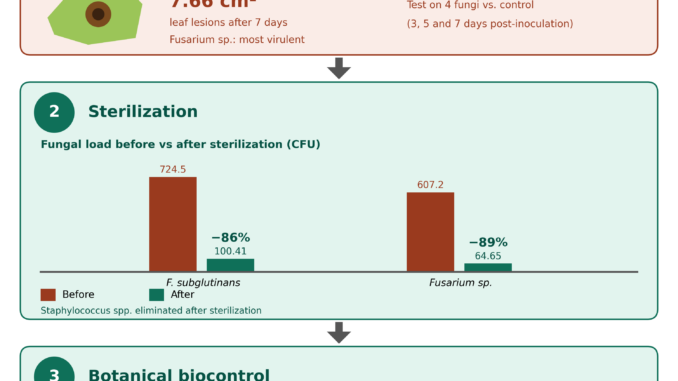
Potato production is on the increase in tropical regions, but yields remain low, generally between 3 and 11 t/ha, due to poor seed quality and phytosanitary pressures. First-generation seeds are a promising solution for improving productivity, but they require pathogen-free organic growing substrates (soil, compost, and sand mixtures) to guarantee plant health. The aim of this study, carried out from January to June 2022 in Bayangam, Cameroon, was to assess the microbiological quality of greenhouse substrates and propose biological control strategies. Analyses carried out before and after sterilization revealed high initial contamination of the irrigation water, with 193 CFU/mL total coliforms, making it unfit for use. Bacterial loads, including Streptococcus spp. and Shigella spp., as well as fungal populations such as Fusarium spp., were significantly reduced after sterilization. Pathogenicity tests identified Fusarium sp. as the most virulent, causing lesions of 7.66 cm2 on potato leaves after 7 days. Furthermore, aqueous extracts of Tephrosia vogelii showed high antifungal activity, with inhibition rates reaching 93.71% against Fusarium subglutinans. These results demonstrate the importance of rigorous control of the microbiological quality of substrates and confirm that sterilization, combined with the use of botanical extracts, represents a sustainable alternative to chemical pesticides, thus contributing to healthy seed production and food security in Cameroon.
Keywords: Potatoes, Microbiological quality, Sterilization, Pathogenicity, West Cameroon.
RÉSUMÉ
La production de pomme de terre connaît un essor dans les régions tropicales ; néanmoins, les rendements demeurent faibles, s’établissant généralement entre 3 et 11 t/ha, en raison de la piètre qualité des semences et des pressions phytosanitaires. Les semences de première génération constituent une solution prometteuse pour accroître la productivité, mais elles exigent des substrats organiques de culture (mélanges de sol, compost et sable) exempts de germes pathogènes afin de garantir la santé des plants. L’objectif de cette étude, menée de janvier à juin 2022 à Bayangam (Cameroun), était d’évaluer la qualité microbiologique de substrats sous serre et de proposer des stratégies de lutte biologique. Les analyses réalisées avant et après stérilisation ont révélé une forte contamination initiale de l’eau d’irrigation, affichant 193 UFC/mL de coliformes totaux, la rendant ainsi impropre à la consommation. Les charges bactériennes, incluant Streptococcus spp. et Shigella spp., ainsi que les populations fongiques telles que Fusarium spp., ont été significativement réduites à la suite de la stérilisation. Les tests de pathogénicité ont permis d’identifier Fusarium sp. comme le germe le plus virulent, occasionnant des lésions de 7,66 cm² sur les feuilles de pomme de terre au terme de 7 jours. En outre, les extraits aqueux de Tephrosia vogelii ont manifesté une activité antifongique élevée, avec des taux d’inhibition atteignant 93,71 % à l’encontre de Fusarium subglutinans. Ces résultats démontrent l’importance d’un contrôle rigoureux de la qualité microbiologique des substrats et confirment que la stérilisation, conjuguée à l’emploi d’extraits botaniques, représente une alternative durable aux pesticides chimiques, contribuant ainsi à une production semencière saine et à la sécurité alimentaire au Cameroun.
Mots-clés : Pomme de terre, Qualité microbiologique, Stérilisation, Pathogénicité, Ouest-Cameroun.
REFERENCES
Dagbénonbakin, G., A. Saïdou, & F. Toukouro (2017). Utilisation des microorganismes du sol pour accroître la productivité agricole : Manuel de l’apprenant. CNS-Maïs/INRAB/SNRA, 38 p.
Alo S (2021). Adaptability of Released Potato (Solanum tuberosum L.) Varieties at Masha and Chena, Southwestern Ethiopia. World Journal of Agriculture and Soil Science. https://doi.org/10.33552/ wjass.2021.06.000646
Balwinder S, Kumar A and Singh R (2015). Study on Hydrolysis of Hydrogen Peroxide by Enzymes. Journal of Research in Biology 12(3), 45–56.
Biessy A, Cadieux M, Ciotola M, St-Onge R, Blom J and Filion M (2024). Virulence determinants are unevenly distributed within Streptomyces species and strains causing potato common scab in the province of Quebec, Canada. Plant Disease, 108(12), 3527–3539. https://doi.org/10.1094/PDIS-04-24-0744-RE
Bio-Rad Laboratories (2016). Urea Indole medium: Technical data sheet. Bio-Rad Laboratories. https://www.pub compare.aiproduct/sjLiCZIBBPBHhf-iFvbyZ/
Bradford SA, Morales VL, Zhang W, Harvey RW, Packman AI, Mohanram A and Welty C (2013). Transport and Fate of Microbial Pathogens in Agricultural Settings. Critical Reviews in Environmental Science and Technology, 43(8), 775–893. https://doi.org/10.1080/10643389.2012.710449
Busto M, Tarifa EE, Cristaldi M, Badano JM and Vera CR (2022). Simulation of thermal sanitization of air with heat recovery as applied to airborne pathogen deactivation. International Journal of Environmental Science and Technology, 19(12), 11685–11698. https://doi.org/10.1007/s13762-022-03948-9
Chelahi CM and Benguerba KI (2021). Isolement et identification des champignons phytopathogènes de la pomme de terre. Masters Thesis, Université des Frères Mentouri Constantine, République Algérienne Démocratique Et Populaire, 64p.
Chiankem BN (2022). Impacts and Adaptation of Small-scale Potato Farmers to Climate Change in the Western Highlands of Cameroon. Masters Thesis, University of Bergen, Norway, 140p. https://bora.uib.no/bora-xmlui/handle/11250/3014189
Devaux A, Kromann P and Ortiz O (2014). Potatoes for Sustainable Global Food Security. Potato Research 57(3), 185–199. https://doi.org/10.1007/s11540-014-9265-1
Dongmo GZ, Djeugap JF, Fenohi N, Kenfack ND, Takuete R and Teguefouet P (2017). Contribution to the identification of post-harvest fungi associated with Ricinodendron heudelotii and Garcinia kola kernels collected in the West Highlands of Cameroon. International Journal of Biological and Chemical Sciences 11(4), 1840–1850. http://dx.doi.org/10.4314/ijbcs.v11i4.33
FAO (2024). FAOSTAT 2024 : la production mondiale de pommes de terre augmente malgré la diminution des surfaces récoltées. https://www.freshplaza.fr/article/9694050/faostat-la-production-mondiale-de-pommes-de-terre-augmente-malgre-la-diminution-des-surfaces-recoltees/ accessed 02 May 2025
Feurhuber M, Taupitz T, Mueller F, Frank C, Hochenauer C and Schwarz V (2024). A method to investigate sterilization processes and the bacterial inactivation resolved in time and space. PDA Journal of Pharmaceutical Science and Technology, 78(3), 331–347. https://doi.org/10.5731/pdajpst.2022.012771
GIZ (2019). Organic Potato Cultivation 2019. https://www.organic-africa.net/fileadmin/organic-africa /documents/training-manual/chapter-09/Pommes-de-terre-bio-Cameroun_Version-Prel-Fev-2019.pdf, 76p.
Gullino ML, Garibaldi A, Gamliel A and Katan J (2022). Soil Disinfestation: From Soil Treatment to Soil and Plant Health. Plant Disease, 106(6), 1541–1554. https://doi.org/10.1094/PDIS-09-21-2023-FE
Hudaib T (2024). Exploring Efficient Sterilization Methods for Mushroom Picking Cups in Automated Picking Technology. Scientific Reports. https://doi.org/10.54985/peeref.2406p1570433
Joseph Etoundi O (2023). Afrique: le rendement élevé de la pomme de terre, un trésor enfoui. Invest-Time. https://invest-time.com/2023/10/19/afrique-le-rendement-eleve-de-la-pomme-de-terre-un-tresor-enfoui/
Karanja AM, Shisanya C and Makokha G (2014). Analysis of the Key Challenges Facing Potato Farmers in Oljoro-Orok Division, Kenya. Agricultural Sciences, 5(10), 834–838. https://doi.org/10.4236/as.2014.510088
Kooman P (2019). Improving tropical potato production. Potato World. https://potatoworld.eu/magazine/02-2019/improving-tropical-potato-production/
McGuire S and Sperling L (2013). Making seed systems more resilient to stress. Global Environmental Change 23(3), 644–653. https://doi.org/10.1016/j.gloenvcha.2013.02.001
Mlozi S, Mmongoyo J and Chacha M (2020). Antimicrobial activities of Tephrosia vogelii against selected pathogenic fungi and bacterial strains. Mycology 11, 49–55. https://doi.org/10.1080/21501203.2019.1705929
Mohamed N (2019). La pomme de terre dans tous ses états. Afrique Agriculture. https://www.afrique-agriculture.org/articles/filieres/la-pomme-de-terre-dans-tous-ses-etats
Murray PR, Rosenthal KS, Kobayashi G and Pfaller MA (2003). Medical Microbiology, 4th Edition. ISBN: 0323012132.
Ntangmo Tsafack H, Saah Fokou CA, Wamba FR, Akwa TE, Pokam Djoko GR and Temgoua E (2024). Bacteriological and parasitological assessment of vegetables collected from markets in Mbouda, West Cameroon. Journal of Food Safety and Hygiene 10(4), 297–311. https://doi.org/10.18502/jfsh.v10i4.19394
Ombala R (2013). Étude de l’accessibilité à l’eau potable dans les villages pilotes du projet d’irrigation complémentaire et d’information climatique dans la commune de Kongoussi. https://idl-bnc-idrc.dspacedirect.org/items/af70aa4e-b055-4070-8ac2-a80ed0765ed0
Pacheco HGJ, Banda AAP, Cayllahua EIV, Ramos LMM, Tohalino VLA, Beltran HJDC and Sarmiento PKD (2023). New electrogenic microorganism Citrobacter sp. isolated from a microbial fuel cell and bacterial characteristics determination. Energies 16(7), 3047. https://doi.org/10.3390/en16073047
Portères R (1947). The Potato in Tropical Africa. Journal of Traditional Agriculture and Applied Botany 27(299), 341–352.
Razavi S, Dupont J, Martin A and Leroy P (2007). Sampling methods for organic substrates. Journal of Soil Science 15(3), 245–256. https://doi.org/10.1234/jss.2007.54321
Rejeb Gharbi F and El Fahem M (2007). Prospects for potato seed production using micropropagation in Tunisia. BASE. https://popups.uliege.be/1780-4507/index.php?id=745
Salem JH (2009). Extraction, identification, characterization of biological activities of flavonoids from Nitraria retusa and synthesis of acylated derivatives of these molecules by an enzymatic route. PhD Thesis. https://hal.univ-lorraine.fr/tel-01748769
Sawicka B, Umachandran K and Pszczółkowski P (2021). Innovative potato production technology and its influence on quality of tubers. International Conference on Emerging Technology and Interdisciplinary Sciences, 174–195. https://doi.org/10.57040/icetis.vi.16
Shah A, Nazari M, Antar M, Msimbira LA, Naamala J, Lyu D, Rabileh M, Zajonc J and Smith DL (2021). PGPR in Agriculture: A Sustainable Approach to Increasing Climate Change Resilience. Frontiers in Sustainable Food Systems 5. https://doi.org/10.3389/fsufs.2021.667546
Shaw D (1998). Phytophthora Diseases Worldwide by DC Erwin and OK Ribeiro. The Journal of Agricultural Science 131(2), 245–249. https://doi.org/10.1017/S0021859698215796
Teryila A (2015). Phytochemical analysis of Tephrosia vogelii (fish poison bean). Journal of Aquatic Sciences 30(1), 35–41. https://doi.org/10.4314/JAS.V30I1
Temateu KLN, Keegoui G, Mogo JPK, Djoko GRP, Akwa TE, Ngodem VCK [autres auteurs non listés dans le document source] and Temgoua E (2026). Optimizing the Productivity and Profitability of Potato (cv. Jelly) through Sustainable Fertilization in High-altitude Areas of Cameroon. Journal of Agriculture and Ecology Research International 27(4), 117–133. https://doi.org/10.9734/jaeri/2026/v27i4769
Tomilova OG, Kryukova NA, Efimova MV, Kovtun IS, Kolomeichuk LV, Kryukov VY and Glupov VV (2021). Early physiological response of potato plants to entomopathogenic fungi under hydroponic conditions. Horticulturae 7(8), 217. https://doi.org/10.3390/horticulturae7080217
Orsot BAMB, Soro S, Konkon NG, Kone D, Zirihi GN. (2016). Étude ethnobotanique et évaluation in vitro de l’activité antifongique des extraits de l’écorce de Zanthoxylum gilletii (de Wild Waterman) sur deux souches phytopathogènes de Sclerotium rolfsii. Journal of Applied Biosciences, 98(0), 9309. https://doi.org/ 10.4314/jab.v98i1.7