
MACHE ANDRE GILLES1*, ASHU CALVEN NKONGHO1, NOUMO NGANGMOU THIERRY2, BOUBGA CLIFFORD1, LENG MARLYSE SOLANGE3, EJOH RICHAD ABA2
1Department of Biochemistry, Faculty of Science, University of Bamenda, PO Box 39, Bambili, Cameroon.
2Department of Nutrition, Food and Bio-resource Technology, College of Technology, the University of Bamenda, Bambili, Cameroon.
3Department of Basic Science, Institute of Fisheries and Aquatic Sciences (ISH), University of Douala, PO Box 7236, Douala, Cameroon.
*Corresponding author: gillesandremache@yahoo.fr
Received: 19 Oct 2025, Reviewed: 21 Nov 2025, Revised: 07 Dec 2025, Accepted: 15 Jan 2026, Published: 30 Sep 2026.
https://doi.org/10.63342/cjbbs2025.26.34.032.en
ABSTRACT
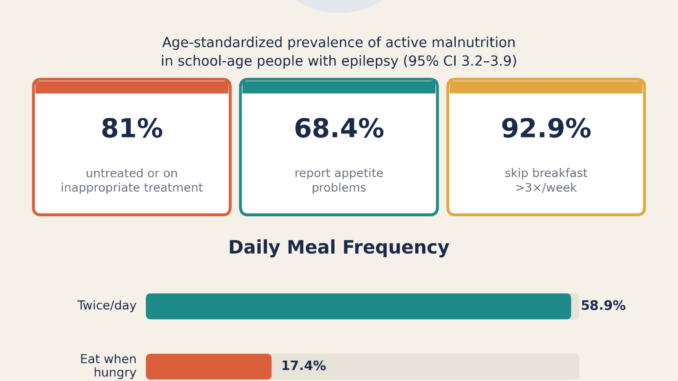
This work aimed to assess the prevalence of epilepsy and the impact of malnutrition in order to improve physical and school performance among school-age people with epilepsy in a rural health district of the North-West Region of Cameroon. Two hundred and fifty-three (253) participants who lived with epilepsy were screened for malnutrition; 223 had active malnutrition in epilepsy. The first results revealed that 75.9% of epileptics (respondents) think that a balanced diet is a diet that is eaten in a time of ill-health, 14.6% think that it is a diet consisting of a suitable proportion of food from all food groups, 7.1% think that it is a diet that provides the body with the right number of nutrients, and 2.4% think that it is a diet that is loaded with a single nutrient. In general, the majority of epileptics did not have the right idea about a balanced diet. Secondly, our results revealed that 58.9% of epileptics eat twice per day, 17.4% eat at any time per day because they are hungry, 12.7% eat thrice per day, and 10.7% eat once per day. The third result revealed that 9.1% of epileptics eat breakfast, and 90.9% don’t. Then, 5.9% of epileptics take snacks between breakfast and lunch, while 94.1% don’t. Findings revealed that 5.9% of epileptics take lunch, while 94.1% don’t. Moreover, 50.2% of epileptics take snacks, and 49.8% of the respondents don’t take them. Also, 49.8% of the respondents eat during supper, and 50.2% don’t. The fourth result shows that the majority of the respondents consume starches, fruits, and vegetables in their various forms 5-6 times a week, 2-4 times a week, and once per week. Most of the respondents don’t consume milk and its products, and 80-85% of the respondents don’t eat animal protein. Out of this 80- 85%, most stated that they might be lucky to eat fish about once or thrice a week. Also, most of the respondents (80-85%) don’t consume high amounts of low-glycemic fats and their products, but don’t consume cakes, candy, cookies, doughnuts, and fruit-flavored drinks, while most of the epileptics consume palm oil and groundnut oil. The fifth result reveals that 68.4% of the respondents have problems with appetite, like always feeling hungry or never feeling hungry; 92.9% of the respondents do skip breakfast more than 3 times a week; and 7.1% don’t. The age-standardized prevalence of active malnutrition in people with epilepsy was 3.5% (95% CI: 3.2-3.9). Overall, the prevalence of active malnutrition in epilepsy varied widely among the households, ranging between 1.2% and 7.7%. The mean age among the participants with epilepsy was between 10 and 29 years. Epilepsy was reported in 59% of people, and the median age at first seizure was 11 years (interquartile range: 8-15). The 1-year incidence of epilepsy was estimated to be 171/100,000 (95% CI: 114.0-254.6). About 81% of people with epilepsy were either untreated or receiving inappropriate treatment. Family history of epilepsy was the main factor associated with epilepsy after multivariate analysis (OR: 6.8; 95% CI: 3.2-14.1). Many parameters like nutrition have an important effect on epileptic seizure’s frequence on human being.
Keywords: Epidemiology. Epilepsy. Malnutrition. School-age people. Batibo-Subdivision. Cameroon.
RÉSUMÉ
L’objectif de cette étude était d’évaluer la prévalence de l’épilepsie et l’impact de la malnutrition afin d’améliorer les performances physiques et scolaires des enfants épileptiques scolarisés dans un district sanitaire rural de la région du Nord-Ouest du Cameroun. Sur 253 participants épileptiques dépistés pour la malnutrition, 223 présentaient une malnutrition active. Les premiers résultats révèlent que 75,9 % des épileptiques interrogés pensent qu’un régime alimentaire équilibré est un régime suivi en cas de maladie, 14,6 % pensent qu’il s’agit d’un régime composé d’aliments en proportions adéquates de tous les groupes alimentaires, 7,1 % pensent qu’il s’agit d’un régime fournissant à l’organisme le nombre approprié de nutriments et 2,4 % pensent qu’il s’agit d’un régime riche en un seul nutriment. De manière générale, il apparaît que la majorité des épileptiques n’ont pas une conception correcte de ce qu’est un régime alimentaire équilibré. Les deuxièmes résultats indiquent que 58,9 % des personnes épileptiques mangent deux fois par jour, 17,4 % mangent à n’importe quel moment de la journée car elles ont faim, 12,7 % mangent trois fois par jour et 10,7 % une seule fois par jour. Les troisième résultats montrent que 9,1 % des personnes épileptiques prennent un petit-déjeuner, tandis que 90,9 % ne mangent pas à ce moment-là. On observe donc que la majorité ne prend pas de petit-déjeuner. Ensuite, 5,9 % des personnes épileptiques prennent une collation entre le petit-déjeuner et le déjeuner, tandis que 94,1 % n’en prennent pas. Ainsi, la majorité des personnes épileptiques ne prennent pas de collation. Les résultats révèlent que 5,9 % des personnes épileptiques mangent au déjeuner, tandis que 94,1 % ne mangent pas à ce moment-là. On constate donc que la plupart des répondants ne mangent pas au déjeuner. Les résultats ci-dessous indiquent que 50,2 % des personnes épileptiques prennent une collation, tandis que 49,8 % des répondants n’en prennent pas. D’après ces résultats, on peut conclure que la majorité des répondants prennent une collation. Les résultats révèlent que 49,8 % des répondants (épileptiques) mangent au dîner, et 50,2 % ne mangent pas au dîner. Par conséquent, on constate que la majorité des répondants ne mangent pas au dîner. Les quatrième résultats montrent que la majorité des répondants (épileptiques) consomment des féculents, des fruits et des légumes, sous leurs diverses formes, 5 à 6 fois par semaine, 2 à 4 fois par semaine et une fois par semaine. La majorité des répondants ne consomme pas de lait ni de produits laitiers. Par ailleurs, 80 à 85 % des répondants ne consomment pas de protéines animales. Parmi les personnes interrogées, 80 à 85 % ont déclaré avoir de la chance de manger du poisson une à trois fois par semaine. La plupart des répondants (80 à 85 %) ne consomment pas de grandes quantités de graisses à faible indice glycémique ni de produits dérivés. De plus, la majorité des répondants ne consomme pas de gâteaux, de bonbons, de biscuits, de beignets ni de boissons aromatisées aux fruits. En revanche, la plupart des épileptiques consomment de l’huile de palme et de l’huile d’arachide. Enfin, les résultats indiquent que 68,4 % des répondants ont des problèmes d’appétit (faim constante ou absence de faim), tandis que 31,6 % n’en ont pas. Par ailleurs, 92,9 % des répondants sautent le petit-déjeuner plus de trois fois par semaine, contre 7,1 % qui ne le font pas. La prévalence de la malnutrition active chez les personnes épileptiques, standardisée selon l’âge, était de 3,5 % (IC à 95 % : 3,2-3,9). La prévalence de la malnutrition active chez les personnes épileptiques variait considérablement d’un ménage à l’autre, allant de 1,2 % à 7,7 %. L’âge moyen des participants épileptiques se situait entre 10 et 29 ans. Les crises étaient focales chez 59 % des personnes, et l’âge médian de la première crise était de 11 ans (intervalle interquartile : 8-15). L’incidence annuelle de l’épilepsie était estimée à 171/100 000 (IC à 95 % : 114,0-254,6). Environ 81 % des personnes épileptiques n’étaient pas traitées ou recevaient un traitement inadapté. Les antécédents familiaux d’épilepsie constituaient le principal facteur associé à l’épilepsie après analyse multivariée (OR : 6,8 ; IC à 95 % : 3,2-14,1). De nombreux paramètres comme la nutrition ont des effets importants sur la fréquence des crises d’épilepsie chez l’être humain.
Mots-clés : Épidémiologie des épileptiques, malnutrition des enfants en âge scolaire, Arrondissement de Batibo, Cameroun.
REFERENCES
Angwafor SA, Bell GS, Ngarka L, Njamnshi TN, Njamnshi AK and Sander JW (2021). Incidence and prevalence of epilepsy and associated factors in a health district in North-West Cameroon: a population survey. Epilepsy & Behavior 121(Part A), 108048. https://doi.org/10.1016/j.yebeh.2021.108048
Anwar H, Khan QU, Nadeem N, Pervaiz I, Ali M and Fayyaz F (2020). Epileptic seizures. Discoveries 8(2), e110. https://doi.org/10.15190/d.2020.7
Asif M (2013). Role of various vitamins in patients with epilepsy. International Journal of Pharmacological Research 3(1). https://doi.org/10.7439/ijpr
Bowman J, Dudek FE and Spitz M (2001). Epilepsy. Encyclopedia of Life Sciences, Nature Publishing Group.
Chekol YT, Arefaynie M and Kassa AA (2022). Determinants of wasting among children aged 6-59 months in North-East Ethiopia: a community-based case-control study. BMJ Open 12, e057887. https://doi.org/10.1136 /bmjopen-2021-057887
Chen W and Chen G (2014). The roles of vitamin A in the regulation of carbohydrate, lipid, and protein metabolism. Journal of Clinical Medicine 3, 453-479.
Dhakal M (2015). Study on nutritional status of 6 months to 59 months children in Panchgachhi VDC and factors associated with it. BND dissertation, Central Campus of Technology, Tribhuvan University, Nepal.
Food Safety and Standards Authority of India (FSSAI) and Ministry of Health and Family Welfare, Government of India (2016). Food Additives 2016. New Delhi, India.
Guo W, Wu J, Wang W, Guan B, Snape D, Baker GA and Jacoby A (2012). The stigma of people with epilepsy is demonstrated at the internalized, interpersonal and institutional level in a specific socio-cultural context: findings from an ethnographic study in rural China. Epilepsy & Behavior 25(2), 282-288. https://doi.org /10.1016/j.yebeh.2012.08.013
Hunter E, Burton K, Iqbal A, Birchall D, Jackson M, Rogathe J, Jusabani A, Gray W, Aris E, Kamuyu G, Wilkins PP, Newton CR and Walker R (2015). Cysticercosis and epilepsy in rural Tanzania: a community-based case-control and imaging study. Tropical Medicine & International Health 20(9), 1171-1179. https://doi.org /10.1111/tmi.12529
Jiloha RC (2010). Biological basis of tobacco addiction: implications for smoking-cessation treatment. Indian Journal of Psychiatry 52(4), 301-307. https://doi.org/10.4103/0019-5545.74303
Joshi PC (2012). Malnutrition in children: a serious public health issue in Nepal. Health Prospect 11, 61-62.
Katz AR (2013). Non-communicable diseases: global health priority or market opportunity? An illustration of the World Health Organization at its worst and at its best. International Journal of Health Services 43(3), 437-458. http://dx.doi.org/10.2190/HS.43.3
Matuja WB, Kilonzo G, Mbena P, Mwango’mbola RL, Wong P, Goodfellow P and Jilek-Aall L (2001). Risk factors for epilepsy in a rural area in Tanzania: a community-based case-control study. Neuroepidemiology 20(4), 242-247. https://doi.org/10.1159/000054797
McKenzie CA, Wakamatsu K, Hanchard NA, Forrester T and Ito S (2007). Childhood malnutrition is associated with a reduction in the total melanin content of scalp hair. British Journal of Nutrition 98(1), 159-164. https://doi.org/10.1017/S0007114507694458
Mung’ala-Odera V, White S, Meehan R, Otieno GO, Njuguna P, Mturi N, Edwards T, Neville BG and Newton CRJC (2008). Prevalence, incidence and risk factors of epilepsy in older children in rural Kenya. Seizure 17(5), 396-404. https://doi.org/10.1016/j.seizure.2007.11.028
Ngoungou EB, Quet F, Dubreuil CM, Marin B, Houinato D, Nubukpo P, Dalmay F, Millogo A, Nsengiyumva G, Kouna-Ndouongo P, Diagana M, Ratsimbazafy V, Druet-Cabanac M and Preux PM (2006). Epidemiology of epilepsy in sub-Saharan Africa: a review. Cahiers de Santé. https://doi.org/10.1684/san.2007.0051
Ngoungou EB, Bhalla D, Nzoghe A, Dardé ML and Preux PM (2015). Toxoplasmosis and epilepsy: systematic review and meta-analysis. PLOS Neglected Tropical Diseases 9(2), e0003525. https://doi.org/10.1371/ journal.pntd.0003525
Njamnshi AK, Angwafor SA, Tabah EN, Jallon P and Muna WFT (2008). General public knowledge, attitudes, and practices with respect to epilepsy in the Batibo Health District, Cameroon. Epilepsy & Behavior. https://doi.org/10.1016/j.yebeh.2008.09.012
Nsengiyumva G, Druet-Cabanac M, Ramanankandrasana B, Bouteille B, Nsizabira L and Preux PM (2003). Cysticercosis as a major risk factor for epilepsy in Burundi, East Africa. Epilepsia 44(7), 950-955.
Pinckard K, Baskin KK and Stanford KI (2019). Effects of exercise to improve cardiovascular health. Frontiers in Cardiovascular Medicine 6, 69. https://doi.org/10.3389/fcvm.2019.00069
Quattrocchi G, Nicoletti A, Marin B, Bruno E, Druet-Cabanac M and Preux PM (2012). Toxocariasis and epilepsy: systematic review and meta-analysis. PLoS Neglected Tropical Diseases 6(8), e1775. https://doi.org/10.1371 /journal.pntd.0001775
Sheth TN, Choudhry NK, Bowes M and Detsky AS (1997). The relation of conjunctival pallor to the presence of anemia. Journal of General Internal Medicine 12, 102-106.
Srivastava A, Mahmood SE, Srivastava PM, Shrotriya VP and Kumar B (2015). Nutritional status of school-age children – a scenario of urban slums in India. Archives of Public Health 70, 8.
Stafstrom CE and Carmant L (2015). Seizures and epilepsy: an overview for neuroscientists. Cold Spring Harbor Perspectives in Medicine 5, a022426. https://doi.org/10.1101/cshperspect.a022426
United Nations Children’s Fund (UNICEF) (1986). The State of the World’s Children 1986. Oxford University Press, Oxford, United Kingdom.
United Nations Children’s Fund (UNICEF) (2012). The State of the World’s Children 2009: Maternal and Newborn Health. UNICEF, New York, USA.
United Nations Children’s Fund (UNICEF) (2015). Health Systems: Improving Performance. UNICEF, New York, USA. ISBN 92 4 156198 X.
Wagner RG, Ngugi AK, Twine R, Bottomley C, Kamuyu G, Gómez-Olivé FX, Connor MD, Collinson MA, Kahn K, Tollman S and Newton CR (2014). Prevalence and risk factors for active convulsive epilepsy in rural northeast South Africa. Epilepsy Research 108(4), 782-791. https://doi.org/10.1016/j.eplepsyres.2014.01.004