
NYAMNGEE AMASE 1*, YUSUF KAYODE ABEL 1 & SANJIB ADHIKARI 2
1Department of Medical Microbiology and Parasitology, Faculty of Basic Clinical Science, College of Health Sciences, University of Ilorin, Nigeria.
2Central Department of Microbiology, Tribhuvan University, Nepal
Corresponding author: anyamngee2010@yahoo.com; nyamngee.a@unilorin.edu.ng
Received: 21 Feb 2026, Reviewed: 19 Mar 2026, Revised: 21 Aug 2026, Accepted: 27 Aug 2026, Published: 08 Nov 2026.
https://doi.org/10.63342/cjbbs2026.34.005.en
ABSTRACT
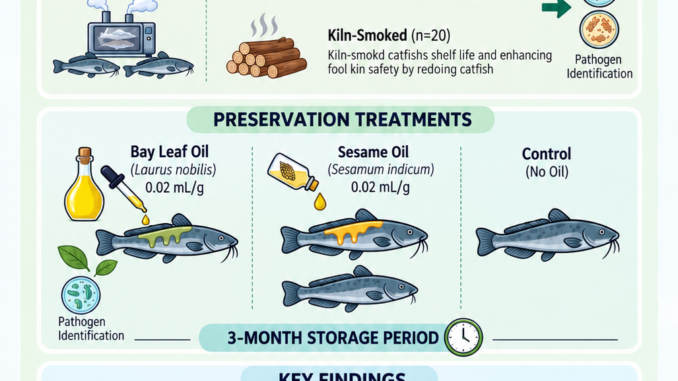
Contamination and postharvest losses determine the availability of fish in marketplaces and have raised public health concerns regarding their quality. We examined the antimicrobial effects of bay leaf (Laurus nobilis) and Sesame seed (Sesamum indicum) oils in preventing deterioration and extending the shelf life of African catfish (Clarias gariepinus). Sixty pieces of freshwater catfish were selected from different spots along the River Niger by randomised mixed sampling method and weighed (26 kg). These samples were divided into three equal (8.6 kg) groups (A, B & C) based on their method of drying: sun-dried (4.2 kg), smoked using firewood (3.9 kg), or smoked in a smoking kiln (3.8 kg). Isolation and identification of spoilage pathogens were performed using selective media, wet preparations, and molecular characterisation before and after drying. Essential oils of Laurus nobilis and Sesamum indicum were extracted through cold press and Soxhlet extraction methods and used at 0.02 mL/g of the fish to coat the dried catfish for preservation. Aliquots from the preserved fish were examined through serial dilution every month for three months. Essential oils from bay leaf inhibited microbial growth and preserved the stored catfish samples better than Sesame seed oil and ordinary drying methods, with microbial reduction count 3.1×10³CFU/g against 4.0×10³ CFU/g of sesame oil and 11.3×10³ CFU/ g of the control; hence, it is recommended for preservation of dried fish.
Key words: Effects, Essential Oils, Postharvest, Catfish, Nigeria.
RÉSUMÉ
La contamination et les pertes après récolte déterminent la disponibilité du poisson sur les marchés et ont suscité des préoccupations de santé publique quant à sa qualité. Nous avons examiné les effets antimicrobiens des huiles de feuilles de laurier (Laurus nobilis) et de graines de sésame (Sesamum indicum) pour prévenir la détérioration et prolonger la durée de conservation du poisson-chat africain (Clarias gariepinus). Soixante spécimens de poissons-chats d’eau douce ont été sélectionnés à différents endroits le long du fleuve Niger selon une méthode d’échantillonnage aléatoire mixte et pesés (26 kg). Ces échantillons ont été divisés en trois groupes égaux (8,6 kg) (A, B et C) selon leur méthode de séchage ; puis séchés au soleil (4,2 kg), fumés au bois de chauffage (3,9 kg) ou fumés dans un séchoir-fumoir (3,8 kg). L’isolement et l’identification des agents pathogènes responsables de l’altération ont été effectués à l’aide de milieux sélectifs, d’examens à l’état frais et d’une caractérisation moléculaire avant et après le séchage. Les huiles essentielles de Laurus nobilis et de Sesamum indicum ont été extraites par des méthodes d’expression à froid et d’extraction au Soxhlet, puis utilisées à raison de 0,02 mL/g de poisson pour enrober le poisson-chat séché en vue de sa conservation. Des aliquotes de poisson conservé ont été examinées par dilutions en série chaque mois pendant trois mois. Les huiles essentielles de feuilles de laurier ont mieux inhibé la croissance microbienne et mieux conservé les échantillons de poisson-chat stockés que l’huile de graines de sésame et les méthodes de séchage ordinaires, avec un décompte de réduction microbienne de 3,1×10³ UFC/g contre 4,0×10³ UFC/g pour l’huile de sésame et 11,3×10³ UFC/g pour le témoin ; elles sont donc recommandées pour la conservation du poisson séché.
Mots-clés: Effets, Huiles essentielles, Post-récolte, Poisson-chat, Nigéria.
REFERENCES
Abdel GR, Garhy M and Morsy K (2015). Prevalence and Intensity of Helminth Parasites of African Catfish Clarias gariepinus in Lake Manzala, Egypt. Advances in Bioscience and Biotechnology 6(7), 464-469. http://dx.doi.org/10.4236/abb.2015.67048
Balouiri M, Sadiki M and Ibnsouda SK (2016). Methods for in vitro evaluating antimicrobial activity: A review. Journal of Pharmaceutical Analysis 6(2), 71-79. https://doi.org/10.1016/j.jpha.2015.11.005
Cheesebrough AP (2006). District Laboratory Practice in tropical countries. Cambridge University Press, United Kingdom, Pg 434-438.
Enyidi UD and Eneje U (2015). Parasites of African catfish Clarias gariepinus cultured in homestead ponds. Researchjournali’s Journal of Agriculture 2015, 2(12):1-10.
Fafioye O and Fafioye O (2013). Microbial identification of smoke-dried fish (Clarias gariepinus) from some local markets in Ibadan metropolis. Journal of Agricultural Research 2(11), 294 – 298.
FAO (2019). Fisheries and Aquaculture statistics. Global aquaculture production 1950-2017. Top 10 species groups in global aquaculture, by Junning Cai, Xiaowei Zhou, Xue Yan, Daniela Lucente and Camilla Lagana 2017. (Fishstat).
Immaculate J, Sinduja P and Jamila P (2012). Biochemical and microbial qualities of Sardinella fimbriata sun-dried in different methods. International Food Research Journal 19 (4),1699-1703.
Ismaila H, Gradder AU, Abdullahi AA and Ladi HD (2025). Postharvest Handling of Fruits in Ganye Local Government Area of Adamawa State, Nigeria. International Journal of Agricultural Research and Biotechnology 8(1), 3027-2610. https://doi.org/10.70382/tijarbt.v08i1.013
Kawe SM, Godspower RO, Balarabe MR and Akaniru RI (2016). Prevalence of gastrointestinal helminth parasites of Clarias gariepinus in Abuja, Nigeria. Sokoto Journal of Veterinary Sciences 14(2), 26-33. http://dx.doi.org/10.4314/sokjvs.v14i2.4
Khasnavis S and Pahan K (2012). Sodium benzoate, a metabolite of cinnamon and a food additive, upregulates neuroprotective Parkinson disease protein DJ-1 in astrocytes and neurons. Journal of Neuroimmune Pharm 7, 424–435. https://doi.org/10.37360/blacpma.23.22.6.56.
Mousavi SA, Ghotaslou R and Kordi SG (2021). Antibacterial and antifungal effects of chitosan nanoparticles on tissue conditioners of complete dentures. International Journal of Biological Macromolecules 118, 881–885. https://doi.org/10.1016/j.ijbiomac.2018.06.130.
Nogueira GF, Soares CT, Cavasini R, Fakhouri FM and Oliveira RA (2019). Bioactive film of arrowroot starch and blackberry pulp: Physical, mechanical and barrier properties and stability of PH and sterilization. Food Chemistry 275, 417-425. https://doi.org/10.1016/j.foodchem.2018.09.054
Odoh VU, Abuh OO, Haruna MM, Yisa MA and Bids A A (2019). Medically Important Parasites of Clarias Garipienus (Catfish) in Nigeria. Adv Biotechnol Microbiol 15(1), 555-594. https://doi.org/10.19080/AIBM.2019. 14.555904
Olajide JA, Oluwole OO and Fayokemi CO (2020). Assessment of bacterial loads of Clarias gariepinus (Burchell, 1822) obtained from cultured and natural habitats. The Journal of Basic and Applied Zoology 81, 32-38. https://doi.org/10.1186/s41936-020-00168-w
Olayemi FF, Adedayo MR, Bamishaiye EI and Awagu EF (2011). Proximate composition of catfish (Clarias gariepinus) smoked in Nigerian stored products research institute (NSPRI): Developed kiln International Journal of Fisheries and Aquaculture 3(5), 96-98. https://doi.org/10.5897/IJFA.9000026
Oluorin KB and Somorin CA (2006). Intestinal helminths of fish of Owa stream South-West Nigeria. Res J Fish Hydrobiol 1(1), 6-9. https://dx.doi.org/10.4314/njpar.v44i1.1
Omeji S, Solomon SG and Idoga ES (2011). A comparative study of the common protozoan parasites of Clariasgariepinus from the wild and cultured environments in Benue State, Nigeria. J Parasitol Res 2011,916-920. https://doi.org/10.1155/2011/916489
Omojowo FS, Omojasola PF, Kolawole MO, Ngwu EO, Oluborode GB and Adetunji CO (2010). Effect of brining on the microbial quality and safety of smoked Catfish, NY Science Journal 3(6), 20-26. ISSN: 1554-0200.
Onyedineke NE, Obi U and Ofoegbu PU (2010). Helminth Parasites of some Freshwater Fish from River Niger at Illushi, Edo State, Nigeria. Journal of Animal Science 6(3),16-21.
Pramaziyah F, Juni T and Heru P (2021). The Effects of Different Concentrations of Bay Leaf Extract on Shelf Life of Preserved Scad Fish, World Vet J 11(3), 431-438. https://dx.doi.org/10.54203/scil.2021.wvj55
Ranasinghe P, Jayawardana R, Galappaththy P, Constantine GR, de Vas Gunawardana N and Katulanda P (2012). Efficacy and safety of “true” cinnamon (Cinnamomum zeylanicum) as a pharmaceutical agent in diabetes: A systematic review and meta-analysis. Diabet. Med 29,1480–1492. https://doi.org/10.1111/j.1464-5491.2012.03718.x.
Serpe FP, Esposito M, Gallo P and Serpe L (2010). Optimisation and Validation of an HPLC Method for Determination of Polycyclic Aromatic Hydrocarbons (PAHs) in Mussel. Food Chemistry 122, 920-925.
Sundramurthy VP, Rajoo NR, Srinivasan NR and Kavitha R (2020). Bioleaching of Zn from sphalerite using Leptospirillum ferriphilum isolate: effect of temperature and kinetic aspect, Applied Biological Chemistry 63 (44), 88-94. https://doi.org/10.1186/s13765-020-00528-8.
Suomalainen LR, Tiirola M and Valtonen ET (2005). The influence of rearing conditions on Flavobacterium columnare infection of rainbow trout. Journal of Fish Diseases 28, 271–277. https://doi.org/10.1111/j.1365-2761.2005.00631.x