
GODSWILL NTSOMBOH NTSEFONG*, MAKONG MADELEINE FLORE, LIKENG-LI-NGUE BENOIT CONSTANT, DZEUFOUO TAPINFO CÉLESTINE MÉLANIE ET AMBANG ZACHÉE
Département de Biologie Végétale, Faculté des Sciences, Université de Yaoundé 1, BP : 812, Yaoundé, Cameroun.
*Auteur Correspondent : ntsomboh@yahoo.fr
Reçu : 27 février 2025, Revu : 04 avril 2025, Révisé : 31 mai 2026, Accepté : 19 août 2026, Publié : 23 septembre 2026
https://doi.org/10.63342/cjbbs2025.26.34.009.fr
RÉSUMÉ
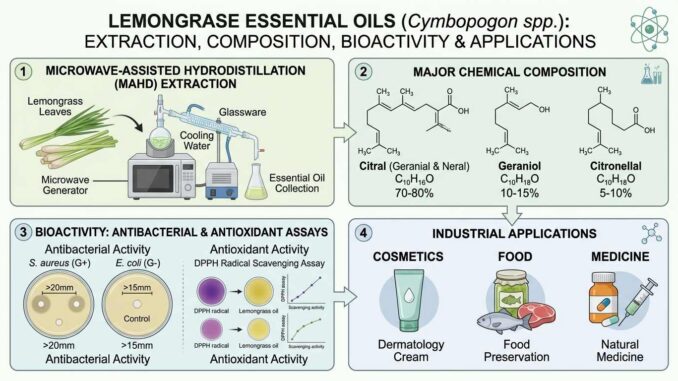
Cet article propose une synthèse exhaustive de la littérature scientifique sur les huiles essentielles (HE) de citronnelle (Cymbopogon spp.), une plante médicinale et aromatique aux applications thérapeutiques et cosmétiques prometteuses. La composition chimique de ces HE se caractérise par une forte variabilité selon l’espèce, l’origine géographique et l’organe végétal, ce qui nécessite une caractérisation chémotypique rigoureuse. Les principaux composés actifs identifiés incluent le citronellal (1,1 % à 45 %), le citronellol (0,2 % à 37,1 %) et le géraniol (2,7 % à 76,6 %). Le C. citratus se distingue par une concentration élevée en citral (jusqu’à 90,4 %), tandis que le C. schoenanthus présente un profil dominé par le limonène (jusqu’à 27,3 %). Les HE de citronnelle démontrent une activité biocide naturelle significative : une efficacité antibactérienne marquée contre les bactéries Gram-positives (Gram+), avec des Concentrations Minimales Inhibitrices (CMI) atteignant 0,125 mg/mL (notamment sur Staphylococcus aureus), tandis que les bactéries Gram-négatives (Gram–) présentent une sensibilité plus modérée, avec des CMI allant de 1,4 à 11,2 mg/mL. Une action fongicide robuste est également observée, particulièrement contre Candida albicans et Aspergillus fumigatus, avec des zones d’inhibition pouvant atteindre 33,1 mm. En outre, les tests de piégeage des radicaux libres (DPPH) révèlent une activité antioxydante puissante, avec des valeurs d’IC50 généralement comprises entre 50 et 200 µg/mL. La maîtrise des paramètres physico-chimiques, tels qu’une densité moyenne de 0,89 g/mL et une viscosité de 3,8–4,6 cSt, est essentielle pour garantir la qualité, l’authenticité et la reproductibilité des HE dans les formulations industrielles. Cette revue souligne l’importance des méthodes d’extraction optimisées, telles que la distillation assistée par micro-ondes (MAHD), pour maximiser les rendements et préserver la qualité thérapeutique des composés. Enfin, les HE de citronnelle s’imposent comme des alternatives naturelles crédibles aux agents synthétiques dans les secteurs de la dermatologie, de la conservation alimentaire et de la santé humaine, bien que leur intégration industrielle nécessite une démarche scientifique rigoureuse, alliant études cliniques et normalisation internationale.
Mots-clés : Cymbopogon spp., Citronnelle, Huiles essentielles, Activité antimicrobienne, Activité antioxydante, Composition physico-chimique, CMI, Citral, Géraniol.
ABSTRACT
This article provides an exhaustive synthesis of existing scientific literature on the essential oils (EOs) of lemongrass (Cymbopogon spp.), a medicinal and aromatic plant with promising therapeutic and cosmetic applications. The chemical composition of these EOs is characterized by high variability depending on the species, geographical origin, and plant organ, necessitating rigorous chemotypic characterization. The main active compounds identified include citronellal (1.1% to 45%), citronellol (0.2% to 37.1%), and geraniol (2.7% to 76.6%). C. citratus is distinguished by a high concentration of citral (up to 90.4%), while C. schoenanthus presents a profile dominated by limonene (up to 27.3%). Lemongrass EOs demonstrate significant natural biocidal activity: a marked antibacterial efficacy against Gram-positive bacteria, with Minimum Inhibitory Concentrations (MIC) reaching 0.125 mg/mL (notably against Staphylococcus aureus), while Gram-negative bacteria show more moderate sensitivity, with MIC values ranging from 1.4 to 11.2 mg/mL. Robust antifungal action is also observed, particularly against Candida albicans and Aspergillus fumigatus, with inhibition zones reaching up to 33.1 mm. Furthermore, free radical scavenging tests (DPPH) reveal powerful antioxidant activity, with IC50 values generally between 50 and 200 µg/mL. Mastering physical parameters, such as an average density of 0.89 g/mL and a viscosity of 3.8 – 4.6 cSt, is essential to ensure the quality, authenticity, and reproducibility of EOs in industrial formulations. This review highlights the importance of optimized extraction methods, such as microwave-assisted hydrodistillation (MAHD), to maximize yields and preserve the therapeutic quality of the extracted compounds. Finally, lemongrass EOs emerge as credible natural alternatives to synthetic agents in the fields of dermatology, food preservation, and human health, although their industrial integration requires a rigorous scientific approach combining clinical studies and international standardization.
Keywords: Cymbopogon spp., Lemongrass, Essential oils, Antimicrobial activity, Antioxidant activity, Physico-chemical composition, MIC, Citral, Geraniol.
REFERENCES
Aribi-Zouioueche, L., & Couic-Marinier, F. (2021). Huiles essentielles et chiralité moléculaire. Comptes Rendus. Chimie, 24(3), 397-414. https://doi.org/10.5802/crchim.130
Bakkali, F., Averbeck, S., Averbeck, D., & Idaomar, M. (2008). Biological effects of essential oils – A review. Food and Chemical Toxicology, 46(2), 446-475. https://doi.org/10.1016/j.fct.2007.09.106
Baou, A., Bassiloua, J.B., Silou, T., Douguirgue, E., Kedeu, K., & Kalulu, T. (2022). Kinetic modeling of Essential oil extraction from lemongrass acclimatized in Tandjilé in Chad. Asian Journal of Research in Chemistry, 15(3). https://doi.org/10.52711/0974-4150.2022.00041
Bayala, B., Bassole, I. H. N., Gnoula, C., Nebie, R., Yonli, A., Morel, L., … & Simpore, J. (2014). Chemical composition, antioxidant, anti-inflammatory and anti-proliferative activities of essential oils of plants from Burkina Faso. PLoS one, 9(3), e92122. https://doi.org/10.1371/journal.pone.0092122
Bhuana, D. S., Ma’sum, Z., & Mahfud, M. (2021, September). Optimization of extraction of lemongrass leaves (Cymbopogon citratus) with microwave-assisted hydrodistillation using Box-Behnken design. In AIP Conference Proceedings (Vol. 2370, No. 1, p. 080005). AIP Publishing LLC. https://doi.org/10.1063/5.0062180
Biabiany, M., Joseph, H., & Bourgeois, P. (2012). Les épices, plantes à flaveur et médicinales: exemples de quelques espèces aromatiques de Guadeloupe. Phytothérapie, 10(2), 92-99. https://doi.org/10.1007/s10298-012-0692-3
Boudjadja, W., Bouzerzara, S., & Bekka, F. E. (2012). Activité antivirale des huiles essentielles: cas des picornavirus (Doctoral dissertation, Université de Jijel).
Boukhatem, M. N., Ferhat, A., & Kameli, A. (2019). Méthodes d’extraction et de distillation des huiles essentielles: revue de littérature. Une, 3(4), 1653-1659. https://asjp.cerist.dz/en/article/120330
Castilho, P. C., Savluchinske-Feio, S., Weinhold, T. S., & Gouveia, S. C. (2012). Evaluation of the antimicrobial and antioxidant activities of essential oils, extracts and their main components from oregano from Madeira Island, Portugal. Food Control, 23(2), 552-558. https://doi.org/10.1016/j.foodcont.2011.08.031
Dangol, S., Poudel, D. K., Ojha, P. K., Maharjan, S., Poudel, A., Satyal, R., … & Setzer, W. N. (2023). Essential oil composition analysis of Cymbopogon species from Eastern Nepal by GC-MS and chiral GC-MS, and antimicrobial activity of some major compounds. Molecules, 28(2), 543. https://doi.org/10.3390/molecules28020543
Djarallah, M., & Bensaci, M. (2020). Utilisation des huiles essentielles dans la lutte biologique (Doctoral dissertation, Université Kasdi Merbah-Ouargla). https://dspace.univ-ouargla.dz/jspui/handle/123456789/23717
Djerbal, M. (2023). Revue bibliographique sur les huiles essentielles (Doctoral dissertation, Université Mouloud Mammeri).
Elhrech, H., Aguerd, O., El Fessikh, M., Bakrim, S., Khalid, A., Abdalla, A. N., & Bouyahya, A. (2025). Determination of bioactive compounds and investigation of pharmacological properties of Cymbopogon flexuosus L. essential oils. Journal of Molecular Structure, 143576. https://doi.org/10.1016/j.molstruc.2025.143576
Khadri, A., Serralheiro, M. L. M., Nogueira, J. M. F., Neffati, M., Smiti, S., & Araújo, M. E. M. (2008). Antioxidant and antiacetylcholinesterase activities of essential oils from Cymbopogon schoenanthus L. Spreng. Determination of chemical composition by GC–mass spectrometry and 13C NMR. Food chemistry, 109(3), 630-637. https://doi.org/10.1016/j.foodchem.2007.12.070
Kiani, H. S., Ali, A., Zahra, S., Hassan, Z. U., Kubra, K. T., Azam, M., & Zahid, H. F. (2022). Phytochemical composition and pharmacological potential of lemongrass (Cymbopogon) and impact on gut microbiota. Applied Chem, 2(4), 229-246. https://doi.org/10.3390/appliedchem2040016
Kiełtyka-Dadasiewicz, A., Esteban, J., & Jabłońska-Trypuć, A. (2024). Antiviral, antibacterial, antifungal, and anticancer activity of plant materials derived from Cymbopogon citratus (DC.) Stapf Species. Pharmaceuticals, 17(6), 705. https://doi.org/10.3390/ph17060705
Kokabi, E., Bouchart, V., Pronost, S., Lussot-Kervern, I., & Léon-Seck, A. (2024). Caractérisation in vitro de l’effet antimicrobien des huiles essentielles utilisées comme thérapie alternative en médecine vétérinaire équine. Le Nouveau Praticien Vétérinaire-Équine, 1718(1-2), 94-100.
Koul, O., Walia, S., & Dhaliwal, G. S. (2008). Essential oils as green pesticides: Potential and constraints. Biopesticides International, 4(1), 63-84.
Kumoro, A. C., Wardhani, D. H., Retnowati, D. S., & Haryani, K. (2021, February). A brief review on the characteristics, extraction and potential industrial applications of citronella grass (Cymbopogon nardus) and lemongrass (Cymbopogon citratus) essential oils. In IOP Conference Series: Materials Science and Engineering (Vol. 1053, No. 1, p. 012118). IOP Publishing. https://doi.org/10.1088/1757-899X/1053/1/012118
Laguerre, M., Javier López-Giraldo, L., Lecomte, J., Pina, M., & Villeneuve, P. (2007). Outils d’évaluation in vitro de la capacité antioxydante. Oléagineux, Corps Gras, Lipides, 14(5), 278-292. https://doi.org/10.1051/ocl.2007.0140
Lourenço, S. C., Moldão-Martins, M., & Alves, V. D. (2019). Antioxidants of natural plant origins: From sources to food industry applications. Molecules, 24(22), 4132. https://doi.org/10.3390/molecules24224132
Mekhloufi, S., & Hadroug, B. (2024). Étude des huiles essentielles de la plante aromatique citronnelle de la région d’Ouargla (Master’s dissertation, Université Kasdi Merbah Ouargla). https://dspace.univ-ouargla.dz/jspui/handle/123456789/37702
Ndjouondo, G. P., Ngene, J. P., Ngoule, C. C., Kidik, P., Ndjib, R., Dibong, S. D., & Mpondo, M. E. (2015). Inventaire et caractérisation des plantes médicinales des sous-bassins versants Kambo et Longmayagui (Douala, Cameroun). Journal of Animal and Plant Sciences, 25(3), 3898-3916.
Neffati, M., & Sghaier, M. (2014). Développement et valorisation des plantes aromatiques et médicinales (PAM) au niveau des zones désertiques de la région MENA (Algérie, Égypte, Jordanie, Maroc et Tunisie). Observatoire du Sahara et du Sahel : Tunis, Tunisie.
Piaru, S. P., Perumal, S., Cai, L. W., Mahmud, R., Majid, A. M. S. A., Ismail, S., & Man, C. N. (2012). Chemical composition, anti-angiogenic and cytotoxicity activities of the essential oils of Cymbopogon citratus (lemon grass) against colorectal and breast carcinoma cell lines. Journal of Essential Oil Research, 24(5), 453-459. https://doi.org/10.1080/10412905.2012.703496
Purkait, A., Biswas, S., Saha, S., Hazra, D. K., Roy, K., Biswas, P. K. & Kole, R. K. (2019). Formulation of plant-based insecticides, their bio-efficacy evaluation and chemical characterization. Crop Protection, 125, 104907. https://doi.org/10.1016/j.cropro.2019.104907
Ramsey, J. T., Shropshire, B. C., Nagy, T. R., Chambers, K. D., Li, Y., & Korach, K. S. (2020). Essential oils and health. The Yale journal of biology and medicine, 93(2), 291-305.
Rhimi, W., Mohammed, M. A., Zarea, A. A. K., Greco, G., Tempesta, M., Otranto, D., & Cafarchia, C. (2022). Antifungal, antioxidant and antibiofilm activities of essential oils of Cymbopogon spp. Antibiotics, 11(6), 829. https://doi.org/10.3390/antibiotics11060829
Sabrina, D. J. E. H. I. C. H. E. (2022). Effets Thérapeutiques des Huiles Essentielles des Plantes Médicinales (Doctoral dissertation, University Center of Abdalhafid Boussouf-MILA).
Variyana, Y., Ma’Sum, Z., Bhuana, D. S., & Mahfud, M. (2023). Extraction of java lemongrass (Cymbopogon citratus) using microwave-assisted hydro distillation in pilot scale: Parametric study and modelling. ASEAN Journal of Chemical Engineering, 23(2), 210-223.
Wang, H., Zhang, R., Zhang, K., Chen, X., & Zhang, Y. (2022). Antioxidant, hypoglycemic and molecular docking studies of Methanolic extract, fractions and isolated compounds from aerial parts of Cymbopogon citratus (DC.) Stapf. Molecules, 27(9), 2858. https://doi.org/10.3390/molecules27092858
Wu, H., Li, J., Jia, Y., Xiao, Z., Li, P., Xie, Y. & Li, C. (2019). Essential oil extracted from Cymbopogon citronella leaves by supercritical carbon dioxide: antioxidant and antimicrobial activities. Journal of Analytical Methods in Chemistry, 2019(1), 8192439. https://doi.org/10.1155/2019/8192439
Xiao, S., Cui, P., Shi, W., & Zhang, Y. (2020). Identification of essential oils with activity against stationary-phase Staphylococcus aureus. BMC complementary medicine and therapies, 20(1), 99. https://doi.org/10.1186/s12906-020-02898-4
Yahi, A., & Chihab, M. (2024). Exploration ethnobotanique des plantes médicinales employées par les herboristes d’Ain Temouchent pour le traitement des affections gastro-intestinales (Doctoral dissertation).