
ELVIRE HORTENSE BIYE1*, CHRISTIAN DJIMARABEYE1, ATHINA ARELA MADELEINE MENYE2
¹ Plant Biology Department, Faculty of Science, University of Yaoundé I, P.O. Box 812, Yaoundé, Cameroon
2 Camerounaise de Construction du Barrage de Nachtigal, P.O. Box 6283, Ndokoa, Cameroon
*Corresponding author: elvira.hortense@yahoo.com
Received: 28 Jan 2026, Reviewed: 24 March 2026, Revised: 05 May 2026, Accepted: 07 May 2026, Published: 06 Aug 2026
https://doi.org/10.63342/cjbbs2026.34.04.en
ABSTRACT
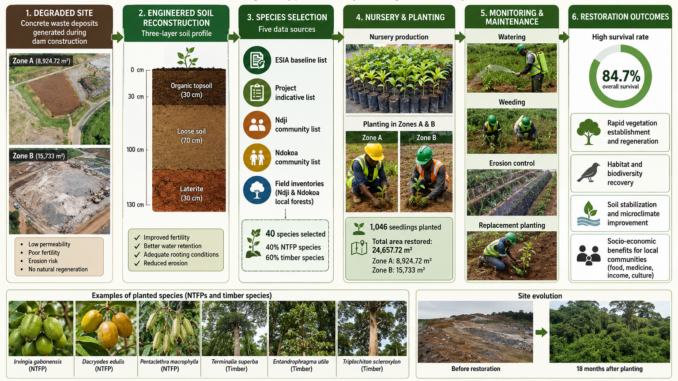
The construction of large hydroelectric infrastructure often leads to significant soil degradation, particularly through the disposal of inert waste. At the Nachtigal Dam construction site in Cameroon, two concrete waste disposal sites in zones A and B were identified for ecological rehabilitation. In this study, we assessed the effectiveness of a three-layered soil remediation technique on the growth of 1,046 plants, selected based on both a survey conducted at the local community on products most commonly used and on an ecological assessment of the surrounding area, across a total area of 24,657.72 m², i.e. 8924.72m2 in zone A and 15733m2 in zone B. A mixed planting strategy incorporating 40% species producing non-timber forest products (NTFPs) and 60% woody species has been implemented to promote ecological functionality and socio-economic benefits. Post-planting monitoring through observation and counting revealed an overall survival of approximately 85%, despite localized erosion and varying survival rates within and between species. Thus, the rehabilitated areas exhibit strong regeneration potential, indicating that engineered soil profiles combined with structured planting of mixed species can effectively restore degraded concrete waste areas. This study sheds light on assisted regeneration practices relevant to large infrastructure projects in tropical forest regions.
Keywords: Assisted reforestation, conservation, inert waste, rehabilitation, soil types.
RÉSUMÉ
La construction de grandes infrastructures hydroélectriques entraîne souvent une dégradation importante des sols, notamment par le dépôt de déchets inertes. Sur le site de construction du barrage de Nachtigal au Cameroun, deux zones de dépôt de déchets en béton, A et B, ont été identifiées en vue d’une réhabilitation écologique. Dans cette étude, nous avons évalué l’efficacité d’une technique de remédiation des sols en trois couches sur la croissance de 1 046 plants, sélectionnés à la fois sur la base d’une enquête menée auprès des communautés locales sur les produits les plus couramment utilisés et d’une évaluation écologique de la zone environnante, établis sur une superficie de 24 657,72 m², soit 8 924,72 m² pour la zone A et 15 733 m² pour la zone B. Une stratégie de plantation mixte intégrant 40 % d’espèces produisant des produits forestiers non ligneux (PFNL) et 60 % d’espèces ligneuses a été mise en œuvre afin de favoriser à la fois la fonctionnalité écologique et les bénéfices socio-économiques. Le suivi post-plantation, basé sur l’observation et le comptage, a révélé un taux de survie global d’environ 85 %, malgré une érosion localisée et des variations de survie au sein et entre les espèces. Les zones réhabilitées présentent ainsi un fort potentiel de régénération, indiquant que des profils de sol reconstitués, combinés à une plantation structurée d’espèces mixtes, peuvent restaurer efficacement des zones dégradées par des déchets de béton. Cette étude met en évidence des pratiques de régénération assistée pertinentes pour les grands projets d’infrastructure en milieu forestier tropical.
Mots-clés : reforestation assistée, conservation, déchets inertes, réhabilitation, types de sols.
REFERENCES
Ahmed Z, Gui D, Murtaza G, Liu Y & Ali S (2023). An overview of smart irrigation management for improving water productivity under climate change in drylands. Agronomy 13(8):2113 https://doi.org/10.3390/ agronomy13082113
Alafi A M, Munguambe F F & Benvindo H (2025). Occurrence, distribution and potential ecological impact of invasive alien plants at Baixo Limpopo irrigation scheme, Mozambique. Discover Conservation 2, 39. https://doi.org/10.1007/s44353-025-00062-4
Andersen L E, Groom B, Killick E, Ledezma J C, Palmer C & Weinhold D (2017). Modelling land use, deforestation and policy: A hybrid optimisation-heterogeneous agent model with application to the Bolivian Amazon. Ecological Economics 135: 76-90.
Bauhus J, Pokorny B, van der Meer P J, Kanowski P J & Kanninen M (2010). Ecosystem goods and services-the key for sustainable plantations. In: Bauhus J, van der Meer P J, Kanninen M (Eds), Ecosystem Goods and Services from Plantation Forests. Earthscan, London, UK, pp. 205-227.
Berga L (2016). The role of Hydropower in climate change mitigation and adaptation: A Review. Engineering 2(3): 313-318.
Bill J III (1999). Restoration: What is it? Journal of Ecological Society 12(1): 29-30.
Bos A B, De Sy V, Duchelle A E, Atmadja S, de Brain S (2020). Integrated assessment of deforestation drivers and their alignment with subnational climate change mitigation efforts. Environ. Sci. Policy 114: 352-365. https://doi.org/10.1016/j.envsci.2020.08.002
Brancalion P H S & Holl K D (2020). Guidance for successful restoration of degraded tropical forest landscapes. Journal of Applied Ecology, 57(12): 2349-2361. https://doi.org/10.1111/1365-2664.13725.
Danise T, Andriuzzi W S, Battipaglia G, Certini G, Guggenberger G, Innangi M, Mastrolonardo G, Niccoli F, Pelleri F & Fioretto A (2021). Mixed-species plantation effects on soil biological and chemical quality and tree growth of a former agricultural land. Forests 12(7):842 https://doi.org/10.3390/f12070842
FAO (2001). Global Forest Resources Assessment 2000. FAO Forestry Paper 140. Rome, FAO, Italy. Fernández‑Caliani J C, Alvarez-Lozano J, Garcia-Navarro E and Fernàndez-Landero S (2024). A Novel Technosol Formulation for Sustainable Landfill Top Covers Using Non‑Hazardous Wastes. Applied Sciences 14(14): 6166. https://doi.org/10.3390/app14146166
Fernandez-Landero S, Fernández‑Caliani J C, Giraldez M I, Hidalgo P J & Morales E (2024). Successful plant growth in acid mine drainage-impacted soil using pot-based experiments with waste amendments. Land Degrad Dev. 35: 4145-4160.
Gastauer M, Cavalcante R B L, Caldeira C F, Nunes S, de S (2020). Structural Hurdles to large- scale forest restoration in the Brazilian Amazon. Front. Ecol. E. 8:1-6.
Ghazoul J & Chazdon R. (2017). Degradation and Recovery in changing forest landscapes: A multiscale conceptual framework. Annual Review of Environment and Resources 42: 161 -188
Hamzaoui R., Sbartai Z M, Benamara A, Ould Chikh L, Boumediene M, Touati N, Bourahla N, Benattou M., & Benmounah A (2024). Development of sustainable construction materials from inert waste mixtures: Environmental issues and mitigation potential. Materials, 17(17): 4301. https://doi.org/10.3390/ma17174301
Kaygusuz K (2009). The role of Hydropower for Sustainable Energy Development. Energy Sources, Part B: Economics, Planning and Policy 4(4) https://doi.org/10.1080/15567240701756889
Killingtveit A (2020). Hydroelectric Power. Future Energy, improved, sustainable and clean options for our planet. 315-330 pp. https://doi.org/10.1016/B978-0-08-102886-5.00015-3
Liu C -L C, Kuchma O & Krutovsky K V. (2018). Mixed-species versus monocultures in plantation forestry: Development, benefits, ecosystem services and perspectives for the future. Global Ecology and Conservation, 15, e00419. https://doi.org/10.1186/s40663-018-0137-9
Löf M, Dey D C, Navarro R M. & Jacobs D F (2012). Mechanical site preparation for forest restoration. New Forests 43(5‑6): 825‑848. https://doi.org/10.1007/s11056‑012‑9332‑x
Lorenzo P & Morais M C (2023). Strategies for the management of aggressive invasive plant species. Plants 12(13) https://doi.org/10.3390/plants 12130482
Manson D G, Schmidt S, Bristow M, Erskine P D & Vanclay J K (2013). Species-site matching in mixed species plantations of native trees in tropical Australia. Agrofor. Syst. 87(1):233-250. https://doi.org/10.1007/s10457-012-9538-0
Moreno-Mateos D, Power M E, Comin F A & Yockteng K (2012). Structural and functional loss in restored wetland ecosystems. Plos Biol. 10(1): e1001247 https://doi.org/10.10.1371/journal.pbio.100.1247
Motzer R (2021). Percentage calculations. Essentials: Fractions, Ratios and Roots. Springer pp 31-33.
Nangia V, Oweis T Y, Kemeze F H & Schnetzer J (2018). Supplemental irrigation: A promising climate-smart practice for dryland agriculture. Climate-Smart Agriculture Practice Brief. Wageningen, Netherlands: CGIAR Research Program on Climate Change, Agriculture and Food Security (CCAFS).
Ngono A V, Manga A D & Biye E H (2021). Régénération assistée de Milicia excelsa (Welw.) C.C. Berg avec des boutures et grains dans la région du Centre au Cameroun. Afrique Science 18(3):1-12
Nghiem N & Tran H (2016). The biodiversity benefits and opportunity costs of plantation forest management: a modelling case study of Pinus radiata in New Zealand. Forests 7(12):297. https://doi.org/10.3390/f7120297
Paquette A, & Messier C (2010). The role of mixed-species plantations in forest restoration. Forest Ecology and Management 257(3): 790–795. https://doi.org/10.1016/j.foreco.2009.07.012
Pawson S M, Brin A, Brockerhoff E G, Lamb D, Payn T W, Paquette A & Parrota J A (2013). Plantation forests, climate change and biodiversity. Biodivers. Conserv. 22(5):1203-1227. https://doi.org/10.1007/s10531-013-0458-8
Qui H, Tang Y & Chen W (2026). Reservoir construction and deforestation. World Development 202, 107351. https://doi.org/10.1016/j.worlddev.2026.107351
Rai P K & Singh J S (2020). Invasive alien plant species: Their impact on environment, ecosystem services and human health. Ecological Indicators 111, article ID 106020. https:// doi.org/ 10.1016/j.ecolind.2019.106020
Santini N S & Miquelajauregui Y (2022). The restoration of degraded lands by local communities and indigenous peoples. Front. Conserv. Sci. 3. https://doi.org/10.3389/fcosc.2022.873659
Shuvar I, Korpita H, Shuvar A, Shuvar B & Kropyvnytskyi R (2021). Invasive plant species and consequences of its prevalence in biodiversity. BIO Web of Conferences 31:00024 https://doi.org/10.1051/bioconf/20213100024
Shyu C W (2020). Energy poverty alleviation in Southeast Asian countries: Policy implications for improving access to electricity. J. Asian Public Policy 15: 97-121
Sze J S, Carrasco L R, Childs D, Edwards D P (2022). Reduced deforestation and degradation in indigenous lands pantropically. Nat. Sustain. 5: 123-130.
Tchatchou B, Sonwa D J, Ickowitz A, & Cerutti P O (2015). Deforestation and forest degradation in the Congo Basin: A socio-economic analysis of the drivers. Occasional Paper 144. Center for International Forestry Research (CIFOR). https://www.cifor-icraf.org/publications/pdf_files/OccPapers/OP-144.pdf
Tongkoom K, Marohn C, Piepho HP, & Cadish G (2021). Combining farmers and scientists’ tree species and soil fertility assessment for improved cropping decisions in Swidden systems of Northern Thailand. Ecol. Indic. 127, 107719. https://doi.org/10.1016/j.ecolind.2021.107719
Tuyizere, M.N., Nyandwi, E., Rwanyiri, E.M., Ndera, J., Mugunga, C.P., Ndagijwenimana, R.N., Ishimwe, A. & Nzayisenga, I. (2025). Regulatory and socio-economic factors shaping forest landscape restoration in the Congo-Nile Crest. Academia Environmental Sciences and Sustainability 2. https://doi.org/10.20935/AcadEnvSci7794
West P W (2014). Growing plantation forests. Springer International Publishing, Cham, Switzerland.
Xiong Q, Shen W, Liu C, Zhang X, Tang W, Duffield C F, Hui F K P & Zhang L (2024). Impact of access to electricity and socio-economic environment on poverty reduction: An empirical study on Myanmar. Energies 17(21): 5451. https://doi.org/10.3390/en17215451