
TIOTSIA TSAPI ARMAND1,2,*, DEFO TAMGNO ERIC3,4, FOSSI MARTIN1, MAGNE TAMOUFE GAELLE4, ETHGEN OLIVIER3, NGUEFACK-TSAGUE GEORGES5 and JULES ROGER KUIATE1,6
1Faculty of Sciences and Technology, Evangelical University Institute of Cameroon, P.O. Box 127 Mbouo-Bandjoun, Cameroon.
2Department of Infectious Diseases, Microbiology and Public Health; University of Rome “La Sapienza”, Piazzale Aldo Moro 5, 00185 Rome, Italy.
3Department of Public Health, Epidemiology and Health Economics, University of Liege, 13 Hippocrate Avenue, 4000 Liege, Belgium.
4Association HEADA Cameroon, P.O. Box 1085 Mduf-Fouda Ada CRESAR Yaounde, Cameroon.
5Department of Public Health, Faculty of Medicine and Biomedical Sciences, University of Yaoundé I, P.O. Box 1364 Kribi Road, Yaounde, Cameroon.
6Department of Biochemistry, University of Dschang, P.O. Box 154 Dschang, Cameroon.
*Corresponding author: tiotsatsapi.armand@uecam.org, tsapi.armand@gmail.com
Received: 27 Oct 2025, Reviewed: 27 Feb 2026, Revised: 06 Mar 2026, Accepted: 22 Jul 2026, Published: 22 Aug 2026
https://doi.org/10.63342/cjbbs2025.26.34.033.en
ABSTRACT
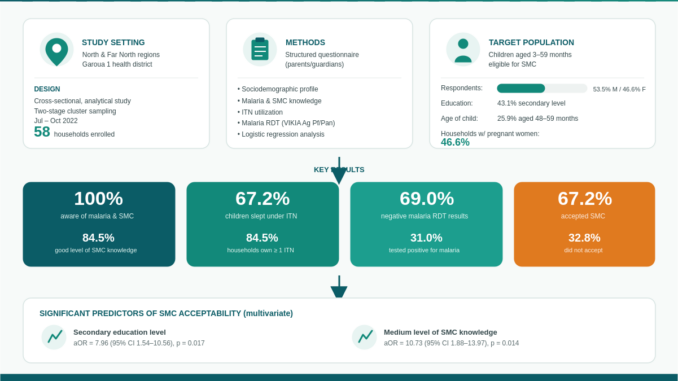
Malaria is a significant challenge in sub-Saharan Africa, especially in Cameroon, where children under 5 years of age are disproportionately affected. The WHO recommends seasonal malaria chemoprevention (SMC) for children aged 3-59 months in areas of high seasonal transmission. Conducted in northern Cameroon from December 2021 to June 2022, this cross-sectional study aimed to assess SMC acceptability among parents of children under 5. Structured questionnaires collected data from 58 households on sociodemographic, malaria and SMC knowledge, insecticide-treated net (ITN) utilization, child malaria positivity, and SMC acceptability. Logistic regression identified predictors of SMC acceptability. Respondents from 58 households, mostly with secondary education, showed high awareness of malaria and SMC and good preventive knowledge. ITN utilization varied. A total of 68.97% of the children tested for malaria were negative. Overall, 67.24% accepted SMC, with education and SMC knowledge as significant predictors. This study highlights the acceptability of SMC among parents of children under 5 in northern Cameroon. Achieving full SMC coverage and adherence remains challenging despite widespread awareness. Considering factors such as education and SMC knowledge, targeted interventions are crucial for reducing the malaria burden in this vulnerable population.
Keywords: Malaria, Seasonal Malaria chemoprevention, Cameroon, Children under 5. Acceptability.
RÉSUMÉ
Le paludisme constitue un défi majeur en Afrique subsaharienne, en particulier au Cameroun, où les enfants de moins de 5 ans sont touchés de manière disproportionnée. L’OMS recommande la chimioprévention saisonnière du paludisme (CSP) pour les enfants âgés de 3 à 59 mois dans les zones à forte transmission saisonnière. Menée dans le Nord du Cameroun de décembre 2021 à juin 2022, cette étude transversale visait à évaluer l’acceptabilité de la CSP auprès des parents d’enfants de moins de 5 ans. Des questionnaires structurés ont permis de recueillir des données auprès de 58 ménages, notamment les caractéristiques sociodémographiques, les connaissances relatives au paludisme et à la CSP, l’utilisation des moustiquaires imprégnées d’insecticide (MII), la prévalence du paludisme chez les enfants et l’acceptabilité de la CSP. Une régression logistique a permis d’identifier les facteurs prédictifs de l’acceptabilité de la CSP. Les personnes interrogées issues de 58 ménages, pour la plupart ayant suivi des études secondaires, ont fait preuve d’une forte sensibilisation au paludisme et à la CSP, ainsi que de bonnes connaissances en matière de prévention. L’utilisation des MII était variable. Au total, 68,97 % des enfants testés pour le paludisme se sont révélés négatifs. Globalement, 67,24 % des parents acceptaient la CSP; le niveau d’éducation et les connaissances sur cette approche constituant des facteurs prédictifs significatifs. Cette étude met en évidence l’acceptabilité de la CSP chez les parents d’enfants de moins de 5 ans. Atteindre une couverture et une observance complètes de la CSP reste un défi malgré une sensibilisation généralisée. Compte tenu de facteurs tels que le niveau d’éducation et les connaissances sur cette intervention, des actions ciblées sont essentielles pour réduire le fardeau du paludisme au sein de cette population vulnérable.
Mots-clés: Paludisme, chimioprévention saisonnière contre le paludisme, Cameroun, enfants de moins de 5 ans, acceptabilité.
REFERENCES
Affoukou, C., Damien, G., Lègba, T., Richard, O., Boni, B., Padonou, G., Aïkpon, R., Houndjo, W., Houetohossou, C., Sohizoun, E., Ogouyemi, A. and Aguèmon, B. (2024) ‘Coverage and Factors Associated with Acceptance and Satisfaction of Seasonal Malaria Chemoprevention in Six Health Zones in Benin’, Open Journal of Preventive Medicine, 49–60. https://doi.org/10.4236/ojpm.2024.143005.
Apinjoh, T.O., Anchang-Kimbi, J.K., Mugri, R.N., Tangoh, D.A., Nyingchu, R., Chi, H.F., Tata, R.B., Njumkeng, C., Njua-Yafi, C. and Achidi, E.A. (2015) ‘The effect of Insecticide Treated Nets (ITNs) on plasmodium falciparum infection in rural and semi-urban communities in the South West Region of Cameroon’, PLoS ONE, 10(2), 1–13. https://doi.org/10.1371/journal.pone.0116300.
Bakai, T.A., Thomas, A., Iwaz, J., Oubou, T.A., Tchadjobo, T., Khanafer, N., Rabilloud, M. and Voirin, N. (2022) ‘Effectiveness of seasonal malaria chemoprevention in three regions of Togo : a population ‑ based longitudinal study from 2013 to 2020’, Malaria Journal, 1–11. https://doi.org/10.1186/s12936-022-04434-w.
Bisanzio, D., Keita, M.S., Camara, A., Guilavogui, T., Diallo, T., Barry, H., Preston, A., Bangoura, L., Mbounga, E., Florey, L.S., Taton, J.L., Fofana, A. and Reithinger, R. (2024) ‘Malaria trends in districts that were targeted and not-targeted for seasonal malaria chemoprevention in children under 5 years of age in Guinea, 2014-2021’, BMJ Global Health, 9(2), 1–12. https://doi.org/10.1136/bmjgh-2023-013898.
Cairns, M., Ceesay, S.J., Sagara, I.Z., Kessely, H., Gamougam, K., Diallo, A., Sonny, Johnbull Ogboi, D.M., Hulle, S., Eloike, T., Snell Paul, Susana Scott, C.M., Bojang, K. and Bosco, Jean Ouedraogo, A.D. (2021) ‘Effectiveness of seasonal malaria chemoprevention ( SMC ) treatments when SMC is implemented at scale : Case – control studies in 5 countries’, PLoS Medicine, 1–19. https://doi.org/10.1371/journal.pmed.1003727.
CDC (2024) Malaria’s Impact Worldwide. https://www.cdc.gov/malaria/php/impact/index.html (Accessed: 5 March 2026).
CIS (2021) Priority target populations for 2021.
Cissé, B., Ba, E.H., Sokhna, C., NDiaye, J.L., Gomis, J.F., Dial, Y., Pitt, C., NDiaye, M., Cairns, M., Faye, E., NDiaye, M., Lo, A., Tine, R., Faye, S., Faye, B., Sy, O., Konate, L., Kouevijdin, E., Flach, C., Faye, O., Trape, J.F., Sutherland, C., Fall, F.B., Thior, P.M., Faye, O.K., Greenwood, B., Gaye, O. and Milligan, P. (2016) ‘Effectiveness of Seasonal Malaria Chemoprevention in Children under Ten Years of Age in Senegal: A Stepped-Wedge Cluster-Randomised Trial’, PLoS Medicine, 13(11), 1–18. https://doi.org/10.1371/journal.pmed.1002175.
De Cola, M.A., Sawadogo, B., Richardson, S., Ibinaiye, T., Traoré, A., Compaoré, C.S., Oguoma, C., Oresanya, O., Tougri, G., Rassi, C., Roca-Feltrer, A., Walker, P. and Okell, L.C. (2022) ‘Impact of seasonal malaria chemoprevention on prevalence of malaria infection in malaria indicator surveys in Burkina Faso and Nigeria’, BMJ Global Health, 7(5), 1–11. https://doi.org/10.1136/bmjgh-2021-008021.
Diawara, S.I., Konaté, D., Kayentao, K., Mihigo, J., Shaffer, J.G., Sangare, M., Ndabamenye, P., Swedberg, E., Garg, L.W., Gamache, N., Keita, B., Kamate, B., Ndaruhutse, P., Kone, D., Sanogo, V., Tounkara, M., Diakité, M., Doumbia, S. and Eckert, E. (2022) ‘Effect of seasonal malaria chemoprevention in children between 5 and 9 years old in Kita and Bafoulabe districts, Mali’, Parasite Epidemiology and Control, 18(June). https://doi.org/10.1016/j.parepi.2022.e00258.
Kirakoya-Samadoulougou, F., De Brouwere, V., Fokam, A.F., Ouédraogo, M. and Yé, Y. (2022) ‘Assessing the effect of seasonal malaria chemoprevention on malaria burden among children under 5 years in Burkina Faso’, Malaria Journal, 21(1), 1–10. https://doi.org/10.1186/s12936-022-04172-z.
Konate, D., Diawara, S.I., Sogoba, N., Shaffer, J., Keita, B., Cisse, A., Sanogo, I., Dicko, I., Guindo, M.D.A., Balam, S., Traore, A., Kante, S., Dembele, A., Kasse, F., Denou, L., Diakite, S.A., Traore, K., M’Baye Thiam, S., Sanogo, V., Toure, M., Diarra, A., Agak, G.W., Doumbia, S. and Diakite, M. (2023) ‘Effect of a fifth round of seasonal malaria chemoprevention in children aged 5–14 years in Dangassa, an area of long transmission in Mali’, Parasite Epidemiology and Control, 20(January), p. e00283. https://doi.org/10.1016/j.parepi.2022.e00283.
Malone, L., Cm, M.B.A., Grigorenko, E. and Stalons, D. (2017) ‘Determinants of Infant Susceptibility to Malaria During the First Year of Life in South Western Cameroon’, OFID, 2(September), p. 2633851. https://doi.org/10.1093/o.
Mbishi, J.V., Chombo, S., Luoga, P., Omary, H.J., Paulo, H.A., Andrew, J. and Addo, I.Y. (2024) ‘Malaria in under-five children: prevalence and multi-factor analysis of high-risk African countries’, BMC Public Health, 24(1), 1–10. https://doi.org/10.1186/s12889-024-19206-1.
Minsante (2019) 4ème Campagne de chimio prévention du paludisme saisonnier (CPS) chez les enfants de 03 à 59 mois dans les régions du Nord et de l’Extrême-Nord du Cameroun: le Minsante fait le point. https://www.minsante.cm/site/?q=fr/content/4ème-campagne-de-chimio-prévention-du-paludisme-saisonnier-cps-chez-les-enfants-de-03-à-59 (Accessed: 1 March 2026).
Nikiema, S., Soulama, I., Sombié, S., Tchouatieu, A.M., Sermé, S.S., Henry, N.B., Ouedraogo, N., Ouaré, N., Ily, R., Ouédraogo, O., Zongo, D., Djigma, F.W., Tiono, A.B., Sirima, S.B. and Simporé, J. (2022) ‘Seasonal Malaria Chemoprevention Implementation : Effect on Malaria Incidence and Immunity in a Context of Expansion of P . falciparum Resistant Genotypes with Potential Reduction of the Effectiveness in Sub-Saharan Africa’, Infection and Drug Resistance, (August 2022), 4517–4527.
Nsah, B., Ngwayu Nkfusai, C., Lemonge, N., T.C Kuetche, M., Bella, H., Yaya, S., Mokom, S., M. Ambadiang, M., Turbé, V., Dunn, J., Neh Njei, F., René Abomabo, M.H., Fosso, J., Joël Ateba, M. and Saidu, Y. (2025) ‘Enhancing Malaria Surveillance in Cameroon: Findings and Recommendations from a Cross-sectional Nationwide Qualitative Study’, VeriXiv, 1–13. https://verixiv.org/articles/2-59/v1.
Plowe, C. V (2022) ‘Malaria chemoprevention and drug resistance : a review of the literature and policy implications’, Malaria Journal [Preprint]. https://doi.org/10.1186/s12936-022-04115-8.
PNLP (2022) 2021 Annual Activity Report of the National Malaria Control Programme in Cameroon. https://files.aho.afro.who.int/afahobckpcontainer/production/files/Rapport_Annuel_dActivites_du_PNLP_2021.pdf.
PNLP (2023) 2022 Annual Activity Report of the National Malaria Control Programme in Cameroon. https://pnlpcameroun.cm/wp-content/uploads/2025/12/Rapport-Annuel-2022.pdf.
PNLP (2025a) 2024 Annual Activity Report of the National Malaria Control Programme in Cameroon. https://pnlpcameroun.cm/wp-content/uploads/2025/12/Rapport-Annuel-2024.pdf.
PNLP (2025b) Quarterly Epidemiological Bulletin of the National Malaria Control Programme. https://theguardianpostcameroon.com/post/6074/fr/homereport-reveals-over-2.1-million-malaria-cases-within-nine-monthsin (Accessed: 2 March 2026).
UNICEF (2022) Malaria in Africa. https://data.unicef.org/topic/child-health/malaria/. (Accessed: 2 March 2026).
Wharton-smith, A., Baker, K., Roca-feltrer, A. and Rodrigues, M. (2021) ‘Assessment of the Feasibility , Acceptability , and Impact of Implementing Seasonal Malaria Chemoprevention in Nampula Province , Mozambique : Protocol for a Hybrid Corresponding Author ’:, 10, 1–15. https://doi.org/10.2196/27855.
WHO (2012) ‘WHO Policy Recommendation: Seasonal Malaria Chemoprevention (SMC) for Plasmodium falciparum malaria control in highly seasonal transmission areas of’, Global Malaria Programmed, 1(2), 1–4. http://www.who.int/malaria/publications/atoz/smc_report_teg_meetingmay2011.pdf.
WHO (2022) Mobilizing communities to help prevent and control malaria in Cameroon. https://www.who.int/news-room/feature-stories/detail/mobilizing-communities-to-help-prevent-and-control-malaria-in-cameroon (Accessed: 5 March 2026).
WHO (2024) World malaria report 2024: Addressing inequity in the global malaria response. https://iris.who.int/server/api/core/bitstreams/6cd14c66-a2d6-408e-8f4c-7dbed9c46ae8/content.
WHO (2025) World Malaria Report 2025 : Adressing the threat of antimalarial drug resistance. https://cdn.who.int/media/docs/default-source/malaria/world-malaria-reports/world-malaria-report-2025-executive-summary-fre.pdf?download=true&sfvrsn=154ea8d5_15.
Yolande, D.P.F., Helene, K.S., Diomede, N.N., Gabrielle, M.T.M., Yanelle, W., Wilfried, G.W., Nicolas, T. and Sisyi, V.V. (2023) ‘Level of Implementation of Seasonal Malaria Chemoprevention in Children Aged between 3 to 59 Months in Koza, Far North Region of Cameroon’, Open Journal of Pediatrics, 13(05), 707–718. https://doi.org/10.4236/ojped.2023.135079.