
SOLANGE MEYIN A EBONG1,*, MELANIE TOGONODJI BAIDAM1,2, SARAH P. TABLEY NGO MINYEM1, BOYOMO ONANA1
1Laboratory of Microbiology, Faculty of Sciences, University of Yaoundé I, P.O. Box 812, Yaoundé, Cameroun
2Bacteriology Laboratory, The N’Djamena’s National Reference University Hospital, N’Djamena, Chad
*Corresponding author: ebongsolange@yahoo.fr
Received: 26 Jan 2026, Reviewed: 20 Apr 2026, Revised: 06 Jun 2026, Accepted: 18 Jun 2026, Published: 01 Sep 2026
https://doi.org/10.63342/cjbbs2026.34.002.en
ABSTRACT
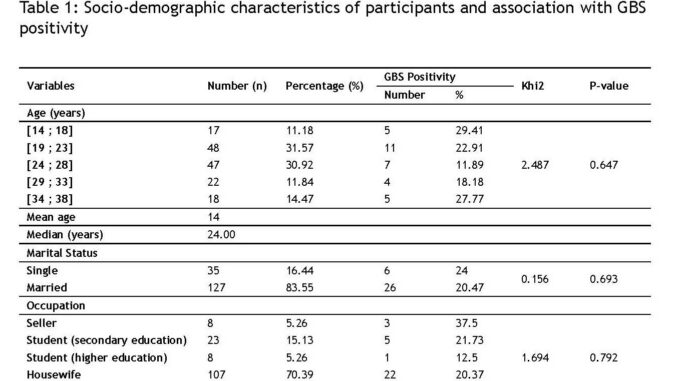
Vaginal carriage of group B streptococcus in pregnant women is generally asymptomatic and often overlooked. This bacterium can cause severe infections in both mother and newborn, resulting in significant mortality and morbidity rates. This study aimed to evaluate the rate of asymptomatic carriage of group B streptococcus in pregnant women in Ndjamena and to assess the resistance profile of isolates obtained. Vaginal swabs collected from participants were subjected to bacteriological analysis. Bacteria were isolated on Columbia agar supplemented with fresh sheep blood, and the resulting colonies were subcultured under the same conditions to obtain pure colonies. Group B streptococcus identification was made using pure colonies and different techniques: control Gram stain, biochemical test (catalase), and the Lancefield test. Antibiogram was based on antibiotics frequently used to treat Group B Streptococcus infection and following EUCAST guidelines. Pregnant women (152) were enrolled in this study, aged from 14 to 38 years, predominantly represented by the age group [19-23 years] N = 48 (31.57%). The majority of women, 107 (70.39%), were housewives, and 100 (65.79%) of them had between 0 and 2 children. Gestational age ranged from 3 to 41 weeks of amenorrhea, and the most represented was [29 – 41 weeks] N= 81 (53.28%). The carriage rate was 21.05%, with cases of co-infection, the most frequent being Group B Streptococcus-Staphylococcus. The number of children per participant, abdominal pain, and itching were statistically associated with Group B Streptococcus carriage. The isolates showed a high level of antibiotic resistance, especially to β-lactams, and sensitivity to vancomycin. Asymptomatic carriage of Group B Streptococcus is a reality in pregnant women, and the isolated strains exhibit a concerning antibiotic resistance profile.
Keywords: vaginal colonization, group B streptococcus, pregnant women, resistance profile, Chad.
RÉSUMÉ
Le portage vaginal du streptocoque du groupe B par la femme enceinte est généralement asymptomatique et souvent ignoré. Cette bactérie peut entraîner des infections sévères tant chez la mère que chez le nouveau-né à l’origine d’un important taux de mortalité et de morbidité. Cette étude visait à évaluer le taux de portage asymptomatique du streptocoque du groupe B par la femme enceinte à N’Djamena et à évaluer le profil de résistance des isolats obtenus. Des prélèvements vaginaux ont été effectués chez les participantes et soumis à une analyse bactériologique. Les bactéries ont été isolées sur gélose Columbia supplémentée en sang de mouton frais, et les colonies obtenues ont été repiquées dans les mêmes conditions afin d’obtenir des colonies pures. L’identification du streptocoque du groupe B a été réalisée à partir de ces colonies pures et par différentes techniques : coloration de Gram, test biochimique (catalase) et test de Lancefield. L’antibiogramme a été établi selon les recommandations de l’EUCAST et en fonction des antibiotiques fréquemment utilisés pour traiter les infections à streptocoque du groupe B. 152 femmes enceintes, âgées de 14 à 38 ans, ont participé à cette étude et la tranche d’âge la plus représentée était celle de [19-23] ans, N = 48 (31,57%). La quasi-totalité des femmes était au foyer N=107 (70,39 %) et 100 d’entre elles (65,79 %) avaient entre 0 et 2 enfants. L’âge gestationnel variait de 3 à 41 semaines d’aménorrhée, et la tranche la plus représentée était celle de [29-41 semaines] N= 81 (53,28%). Le taux de portage était de 21,05% avec des cas de co-infection dont le plus fréquent était le streptocoque du groupe B (Staphylococcus). Le nombre d’enfants par participante, les douleurs abdominales et les démangeaisons étaient statistiquement liés au portage du streptocoque du groupe B. Les isolats ont montré un niveau élevé de résistance aux antibiotiques, surtout aux β-lactamines, et une sensibilité à la vancomycine. Le portage asymptomatique du streptocoque du groupe B est une réalité chez la femme enceinte et les souches isolées présentent un profil de résistance aux antibiotiques inquiétant.
Mots clés: portage vaginal, streptocoque du groupe B, femmes enceintes, profil de résistance.
REFERENCES
Agence Nationale d’Accréditation et d’Evaluation en Santé (ANAES) (2023). Prévention anténatale du risque infectieux bactérien néonatal précoce: Recommandations pour la pratique clinique. Consulted 30 December 2026.
Arif M. Al-Hamad, Mohammed M. Aljeldah, Mahmoud Alsheikh, Ruqayah Gazewi, Maha Al-Ibrahim (2023). Group B Streptococcus Carriage in Pregnancy: Burden of Early-onset Neonatal Disease and Estimation of the Cost of Universal Antenatal Screening in a Hospital of the Eastern Region of Saudi Arabia. Mediterranean Journal of Infection Microbes and Antimicrobials,12 (31). https://doi:10.4274/mjima.galenos.2023.31
Bassir A, Dhibou H, Farah M, Mohamed L, Amal A, Nabila S, Aboulfalah A, Soummani A. (2016) Portage vaginal du streptocoque du groupe B chez la femme enceinte au niveau de la région de Marrakech. Pan African Medical Journal, (23): 107. https://doi:10.11604/pamj.2016.23.107.9047
Black RE, Cousens S, Johnson HL, Lawn JE, Rudan I, Bassani DG, et al., (2010) Global, regional, and national causes of child mortality in 2008: A systematic analysis. The lancet (375), 1969-1987. https://doi:10.1016/S0140-6736(10)60549-1
Bronner P Gonçalves, Simon R Procter, Proma Paul, Jaya Chandna, Alexandra Lewin, Farah Seedat (2022). Group B streptococcus infection during pregnancy and infancy: estimates of regional and global burden. Lancet Glob Health 10 (6), e807–e819. https://doi.org/10.1016/S2214-109X(22)00093-6
CA-SFM/EUCAST. (2023) Recomandations 2023 V1.0 Juin. Consulted 2 February 2024.
Choi Yeseul, Hyung-Soo Han, Gun Oh Chong, Tan Minh Le, Hong Duc Thi Nguyen, Olive EM Lee, Donghyeon Lee, Won Joon Seong, Incheol Seo, and Hyun-Hwa Cha. (2022). Updates on Group B Streptococcus Infection in the Field of Obstetrics and Gynecology. Microorganisms 10(12), 2398. https://doi.org/10.3390/micro-organisms10122398
Foughali HK, Tafer H. (2021). Les candidoses vulvo-vaginales chez la femme enceinte. Mémoire en Sciences Biologiques à l’Université des frères Mentouri Constantine, Algérie. pp 01-85.
Foumane P, Mboudou E, Dohbit JS, Nkemayim DC, Tchokoteu PF, Doh AS (2009). Streptocoque Beta hémolytique du groupe B et conséquences matérno-foetals observées à Hôpital Général de Yaoundé : étude descriptive. Clinics in Mother and Child Health 6(1), 995-1001. Retrieved from https://www.ajol.info/index.php/ cmch/article/view/44719
Group B Strep, (2017). Group B Streptococcus (GBS) in pregnancy and newborn babies. Royal College of Obstetricians & Gynaecologists. https://www.rcog.org.uk/for-the-public/browse-our-patientinforma-tion/group-b-streptococcus-gbs-in-pregnancy-and-newborn-babies/. Consulted 24 April 2026.
Institut National de la Statistique des Etats Economiques et Démographiques (INSEED) (2018). Population du Tchad par région selon le sexe. Consulted 30 December 2023.
Kago I, Tetanye E, Tckokoteu P, Doumbé P, Ndayo M (1990). Les méningites purulentes néotales à Yaoundé Aspects épidémiologiques, cliniques et pronostiques à propos de 71 cas étudiés à HCY. Medicine et Maladies Infectieuses (20), 507–511. https://doi.org/10.1016/S0399-077X(05)80005-8
Lancefield RC, Freimer EH (1966). Type-specific polysaccharide antigens of group B streptococci. Journal of Hygiène (64), 191-203 https://doi.org/10.1017/S002217240004045
Maharane S, Berrah H. (2019). Infections maternofoetales à Streptococcus agalactiae : Etude du portage chez la femme enceinte des infections néonatales et caractérisation des souches invasives. Thèse en Sciences Médicales à l’Université d’AlgerI Algérie.
Mve Koh VS, Mengouna JR, Essiben F, Gonsu Kamga H (2017). Colonisation Génitale et Profil de Sensibilité du Streptocoque du Groupe B chez les Femmes Enceintes dans deux Hôpitaux de Yaoundé. Health Science Disease 18(4),21-25.
Ndeye Safietou Ngom, Omar Gassama, Assane Dieng, Elhadji Bambo Diakhaby, Serigne Mbaye Lo Ndiaye, Alioune Tine et al., (2023). Vaginal Carriage of Group B Streptococcus (GBS) in Pregnant Women, Antibiotic Sensitivity and Associated Risk Factors in Dakar, Senegal. Microbiology Insights 16, 1–10 https://doi.org/10.1177/11786361231174419
Rooyen T. Mavenyengwa, Jan Egil Afset, Berit Schei, Synnøve Berg, Tone Caspersen, Håkon Bergseng, Sylvester R. Moyo (2010). Group B Streptococcus colonization during pregnancy and maternal-fetal transmission in Zimbabwe. Acta Obstetricia et Gynecologica Scandinavica 89(2), 250-255 https://doi.org/10.3109/00016340903398029
Sacheli R, Melin P (2012). Rapport d’activités . CHU de Liège, Centre National de Référence du Streptocoque du groupe B. 01-18.
Sam Oddie & Nicholas D. Embleton (2002). Risk factors for early onset neonatal group B streptococcal sepsis: case-control study. 325: 308
WHO. (2023) Recommandations de l’OMS pour la prévention et le traitement des infections maternelles périnatales. Consulted 30 December 2023.
WHO. (2023) Mortalité maternelle. Consulted 22 february 2024.
WHO (2026). Group B Streptococcus (GBS) https://www.who.int/news-room/fact-sheets /detail/group-b-streptococcus-(gbs). Consulted 24 April 2026.