
KARY MALLAM OUMAROU1, LAME YOUNOUSSA2*, JACOB DOBGANGHA LANGSI3, GEORGE N. MBATA4 and ELIAS NCHIWAN NUKENINE3
1School of Veterinary Medicine and Sciences (ESMV), University of Ngaoundéré, P.O. Box 454, Ngaoundéré, Cameroon
2Department of Animal Biology and Physiology, Faculty of Science, University of Yaoundé 1, P.O. Box 812, Yaoundé, Cameroon
3Department of Biological Sciences, Faculty of Science, University of Ngaoundéré, P.O. Box 454, Cameroon
4Agriculture Research Station, Fort Valley State University, 1005 State University Drive, Fort Valley, GA 31030, USA
*Corresponding author: younoussalame@gmail.com
Received: 19 Mar 2026, Reviewed: 14 Apr 2026, Revised: 18 May 2026, Accepted: 08 Jul 2026, Published: 05 Sep 2026
https://doi.org/10.63342/cjbbs2026.34.008.en
ABSTRACT
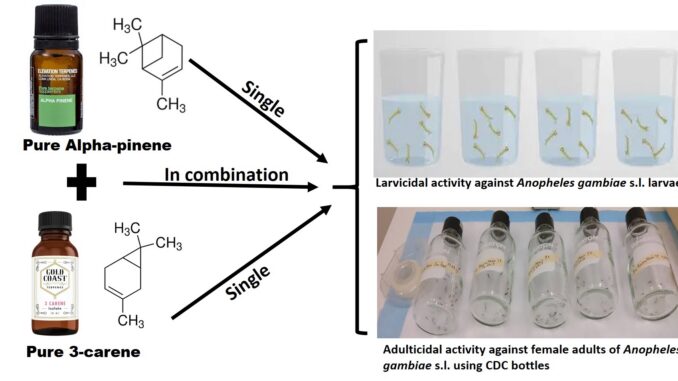
Biopesticides from botanicals are actively being investigated in mosquito control programs. In the current study, two hydrogenated monoterpenes (α-Pinene and 3-Carene were evaluated individually and in combination on fourth-instar larvae and adults of Anopheles gambiae. The terpenes were tested individually and in combination at doses of 6.25, 12.5, 25, 50, and 100 ppm on mosquito larvae, while at 1, 2, 3, and 4 mg/cm2 on the female adults, according to the World Health Organization standard protocol. The commercial insecticide DDVP (WarriorTM), tested at the recommended dose of 1000 ppm, was used as a positive control. The mortality of the larvae and adults was recorded after a 24-h exposure period to the terpenes. Individual and combined application of both terpenes at 100 ppm for larvae, then 4 mg/cm2 for adults, and a positive control (1000 ppm) resulted in 100% mortality of An. gambiae larvae and adults. Tested individually, α-Pinene was also the most toxic to An. gambiae larvae (LC50=8.16 ppm) and adults (LC50=0.98 mg/cm2) compared to 3-Carene (LC50=22.51 ppm on larvae and LC50= 4.31 mg/cm2 on adults). Among the combinations, the mixture 3-Carene 25%+α-Pinene 75% was the most effective on An. gambiae larvae (LC50 = 6.80 ppm) and adults (LC50 = 0.85 mg/cm2), resulting in synergistic actions against mosquito stages compared to the other combinations. Therefore, applications of both hydrogenated monoterpenes are recommended for use in control programs against An. gambiae larvae and adults.
Keywords: Larvicidal, adulticidal, botanical, terpene, Anopheles gambiae.
RÉSUMÉ
Les biopesticides d’origine végétale font actuellement l’objet de recherches actives dans le cadre des programmes de lutte contre les moustiques. Dans la présente étude, deux monoterpènes hydrogénés (α-pinène et 3-carène) ont été évalués individuellement et en combinaison sur des larves de stade IV et des adultes d’Anopheles gambiae. Les terpènes ont été testés individuellement et en combinaison à des doses de 6,25, 12,5, 25, 50 et 100 ppm sur des larves de moustiques, et à des doses de 1, 2, 3 et 4 mg/cm² sur des femelles adultes, selon le protocole standard de l’Organisation Mondiale de la Santé. L’insecticide commercial DDVP (Warrior™), testé à la dose recommandée de 1 000 ppm, a servi de témoin positif. La mortalité des larves et des adultes a été enregistrée après 24 heures post-exposition aux terpènes. L’application individuelle et combinée des deux terpènes à 100 ppm sur les larves et à 4 mg/cm² sur les adultes, ainsi que le témoin positif (1 000 ppm), a entraîné, chacun, une mortalité de 100 % des larves et des adultes d’An. gambiae. Testé individuellement, l’α-pinène s’est également révélé le plus toxique pour les larves d’An. gambiae (CL₅₀ = 8,16 ppm) et les adultes (CL₅₀ = 0,98 mg/cm²) comparés au 3-carène (CL₅₀ = 22,51 ppm chez les larves et CL₅₀ = 4,31 mg/cm² chez les adultes). Parmi les combinaisons, le mélange 25 % de 3-carène + 75 % d’α-pinène s’est révélé comme étant le plus efficace sur les larves d’An. gambiae (CL50 = 6,80 ppm) et les adultes (CL50 = 0,85 mg/cm²), induisant des effets synergiques contre les différents stades de développement des moustiques comparés aux autres combinaisons. Par conséquent, l’utilisation de ces deux monoterpènes hydrogénés pourrait être recommandée dans les programmes de lutte contre les larves et les adultes d’An. gambiae.
Mots-clés : larvicide, adulticide, végétal, terpène, Anopheles gambiae.
REFERENCES
Afolabi OJ (2016). Efficacy of Ocimum grattissimum on adult Anopheles gambiae. Journal of Mosquito Research 9, 1-6. https://doi.org/10.5376/jmr.2016.06.0009
Akinneye JO and Afolabi OJ (2014). Toxicity and fumigant effect of powder and oil extracts of Cleisthopholis Patens (Benth) against larvae and adults of Anopheles mosquitoes. Journal of Mosquito Research 11, 1-6. https://doi.org/10.5376/jmr.2014.04.0011
Ambindei AW, Jazet PDM, Tatsadjieu LN, Priya P, Manilal V, Krishnakumar B and Amvam ZPH (2017). Effect of the essential oils of Thymus vulgaris, Cinnamomum zeylanicum and Mentha piperita on fungal growth and morphology. African Journal of Biotechnology 16, 388-399. https://doi.org/10.5897/AJB2017.15881
Bagavan A, Kamaraj C, Elango G, Zahir AA and Rahuman AA (2009). Adulticidal and larvicidal efficacy of some medicinal plant extracts against ticks, flukes and mosquitoes. Veterinary Parasitology 166, 286-292. https://doi.org/10.1016/j.vetpar.2009.09.007
Batti ACS, Younoussa L, Nukenine EN, Oumarou MK and Fomena A (2019). Larvicidal Activity of two Cymbopogon species leaf extracts and essential oils against Anopheles gambiae Gilles (Diptera: Culicidae). Journal of Applied Life Science International 1, 1-12. https://doi.org/10.9734/JALSI/2019/v21i130096
David JP, Rey D, Pautou MP and Meyran JC (2000). Differential toxicity of leaf litter to dipteran larvae of mosquito developmental sites. Journal of Invertebrate Pathology 75, 9-18. https://doi.org/10.1006/jipa.1999.4886
Dias C and Moraes D (2014). Essential oils and their compounds as Aedes aegypti L. (Diptera: Culicidae) larvicide. Parasitology Research 113, 565-592. https://doi.org/10.1007/s00436-013-3687-6
Enan EE (2005). Molecular and pharmacological analysis of an octopamine receptor from American cockroach and fruit fly in response to plant essential oils. Archives Institute of Biochemistry and Physiology 59, 161-171. https://doi.org/10.1002/arch.20076
Evergetis E, Michaelakis A, Kioulos E, Koliopoulos G and Haroutounian SA (2009). Chemical composition and larvicidal activity of essential oils from six Apiaceae family taxa against the West Nile virus vector Culex pipiens. Parasitology Research 105, 117-124. https://doi.org/10.1007/s00436-009-1370-8
Fang J (2010). Ecology: a world without mosquitoes. Nature 1, 45-49. https://doi.org/10.1038/466432a
Finney DJ (1971). Probit analysis, London: Cambridge University Press, London, United Kingdom, pp. 68-72.
Ignareki DD, Foko DGA, Younoussa L, Njantou EB, Dicko A, Rup-Jacques S, Theno DCB, Nkondjio A, Tamesse JL and Fomena A (2023). Larvicidal efficacy of the combination of Citrus aurantiifolia (Rutaceae) and Lippia chevalieri (Verbenaceae) methanolic extracts against Anopheles gambiae Giles (Diptera: Culicidae), malaria vector. International Journal of Tropical Disease & Health 44(13), 9-20. https://doi.org/10.9734/IJTDH/2023/v44i131448
Kalyanasundaram M and Das PK (1985). Larvicidal and synergistic activity of plant extracts for mosquito control. Indian Journal of Medical Research 82,19-23.
Karunamoorthi K and Sabesan S (2010). Laboratory evaluation of dimethyl phthalate-treated wristbands against three predominant mosquitoes (Diptera: Culicidae) vectors of disease. European Review of Medical and Pharmacological Sciences 14, 443-448. PMID: 20556923
Khater HF (2012). Ecosmart biorational insecticides: Alternative insect control strategies, Insecticides-Advances in integrated pest management, InTech. 7p. https://doi.org/10.5772/27852
Koul O, Walia S and Dhaliwal GS (2008). Essential oils as green pesticides: Potential and Constraints. Biopesticides International 4, 63-84.
Kweka EJ, Lima TC, Marciale CM and De Sousa DP (2016). Larvicidal efficacy of monoterpenes against the larvae of Anopheles gambiae. Asian Pacific Journal of Tropical Biomedicine 3,10-1016. https://doi.org/10.1016/j.apjtb.2016.03.001
Langsi D. Jacob, Hammadou M, Oumarou MK, Nukenine NE, Fokunang NC and Mbata GN (2020). Insecticidal effects of α-Pinene and 3-Carene on Sitophilus zeamais Motschulsky. Insects 11, 8-540. https://doi.org/10.3390/insects11080540
Langsi DJ, Fokunang CN, Suh C, Gwanande AAW, Tsatsop TR and Nukenine EN (2018b). Effectiveness of essential oils from Ngaoundere against post-harvest insect and fungal pests of maize. Proceedings of the 12th International Working Conference on Stored Product Protection (IWCSPP) in Berlin, Germany, 839-847.
Langsi DJ, Tofel HK, Fokunang CN, Suh C, Eloh K, Caboni P and Nukenine EN (2018a). Insecticidal activity of essential oils of Chenopodium ambrosioides and Cupressus sempervirens and their binary combinations on Sitophilus zeamais. GSC Biological and Pharmaceutical Sciences 3, 024-034. https://doi.org/10.30574/gscbps.2018.3.2.0032
Michaelakis A, Vidali VP, Papachristos DP, Pitsinos EN, Koliopoulos G and Couladouros EA (2014). Bioefficacy of acyclic monoterpenes and their saturated derivatives against the West Nile vector Culex pipiens. Chemistry 96, 74-80. https://doi.org/10.1016/j.chemosphere.2013.07.032
Nelson AC and Kursar TA (1999). Interactions among plant defense compounds: a method for analysis. Chemoecology 2, 81-92. https://doi.org/10.1007/s000490050037
Obame LC, Ondo JP and Padzys GS (2016). Ovicidal and larvicidal activities against Anopheles gambiae, antioxidant and antibacterial properties of Aucoumea klaineana Pierre, Canarium schweinfurthii Engl and Dacryodes edulis (G. Don) Lam essential oils from. Gabon. International Journal of Pharmacological Research 1, 68-75. www.ijprjournal.org
Oumarou KM, Younoussa L, Langsi JD, Saotoing P, Nukenine EN (2021). Adulticidal Activity of Hyptis suaveolens, Chenopodium ambrosioides and Lippia adoensis leaf extracts and essential oils against Anopheles gambiae (Diptera: Culicidae). Current Journal of Applied Science and Technology 40(2), 18-32. https://doi.org/10.9734/CJAST/2021/v40i231249
Oumarou MK, Younoussa L and Nukenine EN (2018). Toxic effect of Chenopodium ambrosioides, Hyptis suaveolens and Lippia adoensis leaf methanol extracts and essential oils against fourth instar larvae of Anopheles gambiae (Diptera: Culicidae). International Journal of Mosquito Research. 5:61-66.
Perumalsamy H, Kim NJ and Ahn YJ (2009). Larvicidal activity of compounds isolated from Asarum heterotropoides against Culex pipiens pallens, Aedes aegypti, and Ochlerotatus togoi (Diptera: Culicidae). Journal of Medical Entomology 46, 1420-1423. https://doi.org/10.1603/033.046.0624.
Sun YP and Johnson ER (1960). Synergistic and antagonistic actions of insecticide, synergist combinations and their mode of action. Journal of Agriculture and Food Chemistry 8, 261-266. https://doi.org/10.1021/jf60110a003
Tabanca N, Demirci B, Ali A, Ali Z, Blythe EK and Khan IA (2012). Essential oils of green and red Perilla frutescens as potential sources of compounds for mosquito management. Industrial Crops and Production 65, 36-44. https://doi.org/10.1016/J.INDCROP.2014.11.043
Usta J, Kreydiyyeh S, Bakajian K and Nakkash-Chmaisse H (2002). In vitro effect of eugenol and cinnamaldehyde on membrane potential and respiratory complexes in isolated rat liver mitochondria. Food and Chemical Toxicology 40, 935-940. https://doi.org/10.1016/s0278-6915(02)00071-6
WHO (2005). Guidelines for laboratory and field testing of mosquito larvicides, Geneva: World Health Organization, WHO/CDS/WHOPES/GCDPP/2005, 13.
WHO (2006). Guidelines for testing mosquito adulticides for indoor residual spraying and treatment of mosquito nets. World Health Organization, WHO Bull. 3: 27-39.
WHO (2025). World malaria report 2024. Geneva: World Health Organization; 2025.
Younoussa L, Kenmoe F, Oumarou MK, Batti ACS, Tamesse JL and Nukenine EN (2020). Combined effect of methanol extracts and essential oils of Callistemon rigidus (Myrtaceae) and Eucalyptus camaldulensis (Myrtaceae) against Anopheles gambiae Giles larvae (Diptera: Culicidae). International Journal of Zoology. ID.4952041, 1-9. https://doi.org/10.1155/2020/4952041