
YVAN CEDRIC BATOUM1, ASTRIDE STEPHANIE MOUAFI DJABOU1*, GERTRUDE MEMBANG1,2 & JAMES MICHEL TCHOUMI TCHOTET1,2
1Faculty of Agronomy and Agricultural Science, University of Dschang, Cameroon
2Innovative Plant Health Laboratory, Faculty of Agronomy and Agricultural Sciences, University of Dschang, Cameroon
*Corresponding author: astride.djabou@univ-dschang.org
Received: 28 Jan 2026, Reviewed: 24 Mar 2026, Revised: 05 Jun 2026, Accepted: 07 Jul 2026, Published: 07 Sep 2026
https://doi.org/10.63342/cjbbs2026.34.012.en
ABSTRACT
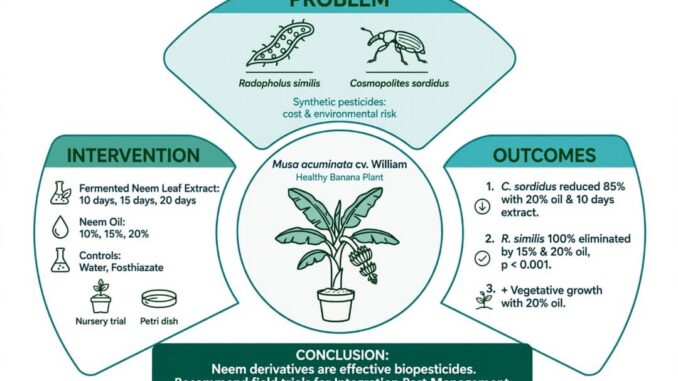
The nematode (Radopholus similis) and the black weevil (Cosmopolites sordidus) are two major threats to banana production. Current pest-control strategies are primarily based on synthetic chemicals, which are associated with environmental risks and substantial costs. The aim of this study was to assess the nematocidal and insecticidal potential of neem leaf extract and neem oil against nematodes and the black weevil affecting banana (Musa acumiata, var. Cavendish ‘William’) production. Treatments included a negative control (water), a positive control (fosthiazate), three levels of fermented neem leaf extracts (fermented for 10, 15, and 20 days), and three levels of neem oil (at 10%, 15%, and 20%) application. The effects of treatments on nematode and weevil populations as well as on plant growth were assessed in nursery conditions. In another set of experiments, the repellence and the anti-feeding in vitro activities of these neem derivative products were evaluated. Results showed a significant reduction in C. sordidus populations with 10-day fermentation neem leaf extract. A complete elimination of R. similis was observed with 15% and 20% neem oil solutions, with no significant difference (P < 0.001) in pseudostem damage compared to the application of the chemical treatment based on fosthiazate. In addition, the application of 20% neem oil showed a positive effect on the vegetative growth of the banana plant. The in vitro test of neem-derived products on black weevil revealed strong repellence and insecticidal activities of neem oil compared to neem leaf extracts. Further evaluation in field conditions with farmers would help to support these observations before the recommendation of neem products for their integration into pest management in banana production.
Keywords: Banana production, black weevil, neem oil, neem leaf extract, nematode repellence.
RÉSUMÉ
Le nématode (Radopholus similis) et le charançon noir (Cosmopolites sordidus) constituent deux menaces majeures pour la production bananière. Les méthodes de lutte contre ces ravageurs reposent principalement sur l’utilisation des produits chimiques de synthèse, qui ont un coût plus élevé mais produisent aussi un impact négatif sur l’environnement. Cette étude visait à évaluer le potentiel nématicide et insecticide des extraits de feuilles de neem fermentées et de l’huile de neem contre le nématode et le charançon noir affectant la production de banane (Musa acuminata, var. Cavendish ‘Williams’). Les traitements incluaient un témoin négatif (eau), un témoin positif (fosthiazate), trois niveaux d’extraits de feuilles de neem fermentées (pendant 10, 15 et 20 jours), et trois concentrations d’huile de neem (10%, 15% et 20%). Les effets des traitements sur les populations de nématodes et de charançons, ainsi que sur la croissance des plantes, ont été évalués en conditions de pépinière. Par ailleurs, les activités répulsives et anti-alimentaires de ces produits dérivés du neem ont été évaluées in vitro. Les résultats ont montré une réduction significative des populations de C. sordidus avec les extraits de feuilles de neem fermentés pendant 10 jours. Par ailleurs, une élimination complète de R. similis a été observée avec les solutions d’huile de neem à 15% et 20%, sans différence significative de dommages sur la pseudo-tige par rapport au traitement chimique à base de fosthiazate. De plus, l’application d’huile de neem à 20% a eu un effet positif sur la croissance végétative des plants de banane. Les tests in vitro des produits dérivés du neem sur le charançon noir ont révélé une forte activité répulsive et insecticide de l’huile de neem par rapport aux extraits de feuilles. Une évaluation supplémentaire en conditions de champ avec les agriculteurs permettrait de confirmer ces observations avant de recommander ces sous-produits du neem et leur intégration dans la gestion des ravageurs en production bananière.
Mots-clés : Production bananière, charançon noir, huile et extraits de feuilles de neem, répulsion des nématodes.
REFERENCES
Ara ZG, Haque AR (2021). A comprehensive review on synthetic insecticides: toxicity to pollinators, associated risk to food security, and management approaches. Journal of Biosystems Engineering 46, 254–272. https://doi.org/10.1007/s42853-021-00104-y.
Aribi N, Béatrice D, Samira K-M, Dominique J (2020). L’azadirachtine, un pesticide naturel aux effets multiples. Médecine/sciences 36, 44–49. https://doi.org/10.1051/medsci/2019268.
Arshad M, Ullah MI, Afzal M, Molina-Ochoa J, Prado-Rebolledo OF, John E (2019). Effect of Neem-based Botanicals and Abamectin 1.8% EC against Phyllocnistis citrella in Citrus reticulata (Rutaceae) Nursery Plantations Foster. Southwestern Entomologist 44, 595–606. https://doi.org/10.3958/059.044.0305.
Assobacam (2022). Association Bananière du Cameroun, Statistiques exportations. Retrieved from: https://assobacam.com/dev/statistiques.
Benelli G, Canale A, Toniolo C, Higuchi A, Murugan K, Pavela R, Nicoletti M (2017). Neem (Azadirachta indica): Towards the ideal insecticide? Natural Product Research 31, 369–386. https://doi.org/10.1080/14786419.2016.1214834.
Coyne DL, Nicol JM, Claudius-Cole B (2010). Les nématodes des plantes : un guide pratique des techniques de terrain et de laboratoire. Cotonou, Institut International d’Agriculture Tropicale. Retrieved from: https://1url.cz/VJbyY.
Da Rocha MR, Marques E, Faria DR, De Filippi MCC, Araújo FG, Teixeira RA (2025). Acibenzolar-S-methyl and Neem Oil in the Management of Nematodes in Sugarcane. Sugar Tech 27, 357–366. https://doi.org/10.1007/s12355-024-01503-z.
Den BH, van de Ven G, van Heerwaarden J, Marinus W, Ronner E, Descheemaeker K, Taulya G (2024). What Shapes Yields of East African Highland Banana? An Explorative Study from Farmers’ Fields. European Journal of Agronomy 156, 127141. https://doi.org/10.1016/j.eja.2024.127141.
Dhakad KA, Kumar R, Choudhary R, Singh S, Khan S, Poonia KP (2025). Traditional to modern perspectives on Neem (Azadirachta indica): A gateway to bioactive compounds, sustainable agrochemicals and industrial applications. Industrial Crops and Products 231, 121155. https://doi.org/10.1016/j.indcrop.2025.121155
Fogain R (2001). Nematodes and weevil of bananas and plantains in Cameroon: Occurrence, importance and host susceptibility. International Journal of Pest Management, 47(3), 201–205. https://doi.org/10.1080/09670870010021108.
Ganda H, Togbé EC, Houndété TA, Boukari ETZ, Gogan M, Dagbénonbakin GD, Kossou DK (2018). Effectiveness of neem seed oil (Azadirachta indica A. Juss: Meliaceae) on Syllepte derogata Fabricius, Lepidoptera: Pyralidae. Journal of Applied Biosciences 129, 13029 -13038, ISSN 1997-5902.
Hafeez UK, Ahmad R, Ahmad W, Khan SM, Ahmad SA (2000). Evaluation of chemical vs. biological control treatments against root-knot nematode Meloidogyne incognita on tomato. Pakistan Journal of Phytopathology 12, 118-120.
Juma P, Njau N, Wacera FW, Micheni CM, Khan HA, Mitalo OW, Odongo D (2022). Trends in neem (Azadirachta indica)-based botanical pesticides. In S. De Mandal, G. Ramkumar, S. Karthi, F. Jin (Eds.): New and future development in biopesticide research: biotechnological exploration. Singapore, Springer. pp. 137–157. https://doi.org/10.1007/978-981-16-3989-0.
Kisaakye J, Fourie H, Haukeland S, Kisitu J, Nakimera S, Cortada L, Subramanian S, Coyne D (2022) Endophytic Non-Pathogenic Fusarium oxysporum-Derived Dual Benefit for Nematode Management and Improved Banana (Musa spp.) Productivity. Agriculture 12, 125.
Kosma P, Ambang Z, Begoude BAD, Hoopen GM, Kuate J, Akoa A (2011). Assessment of nematicidal properties and phytochemical screening of neem seed formulations using Radopholus similis, parasitic nematode of plantain in Cameroon. Crop Protection 30, 733–738. https://doi.org/10.1016/j.cropro.2011.02.026
Kutluer F, Özkan B, Yalçin E, Çavuşoğlu K (2024). Direct and indirect toxicity mechanisms of the natural insecticide azadirachtin based on in-silico interactions with tubulin, topoisomerase and DNA. Chemosphere 364, 143006. https://doi.org/10.1016/j.chemosphere.2024.143006.
Lassoudière A (2007). Le bananier et sa culture. Versailles, Éditions Quæ.
Lata R, Thapa K, Kanojia N, Sharma N, Singh S, Grewal AS, Srivastav AL, Kaushal J (2020). An extensive review on the consequences of chemical pesticides on human health and environment. Journal of Cleaner Production 283, 124657. https://doi.org/10.1016/j.jclepro.2020.124657.
Lengai GMW, Muthomi JW, Mbega ER (2020). Phytochemical activity and role of botanical pesticides in pest management for sustainable agricultural crop production. Scientific African 7, 00239. https://doi.org/10.1016/j.sciaf.2019.e00239.
Membang G, Ambang Z, Mahot HC, Kuate FA, Mokpokpo KKF, Hanna R (2020). Cosmopolites sordidus (Germar) susceptibility to indigenous Cameroonian Beauveria bassiana (Bals.) Vuill. and Metarhizium anisopliae (Metsch.) isolates. Journal of Applied Entomology 144, 468–480. https://doi.org/10.1111/jen.12757.
Minoiu D (2005). Avantage des produits agricoles en Afrique : Appui de la FAO au NEPAD. Rome, Food and Agriculture Organization of the United Nations. Retrieved from: https://1url.cz/mJ9zi.
Murray BI (2004). Factors limiting commercial success of neem insecticides in North America and Western Europe. In O. Koul, S. Wahab (Eds.) Neem: Today and in the new millennium. Boston, Kluwer Academic Publishers. pp. 33–41https://doi.org/10.1007/1-4020-2596-3.
Musabyimana T, Saxena RC, Kairu EW, Ogol CKRO, Khan ZR (2000). Powdered neem seed and cake for management of the banana weevil, Cosmopolites sordidus, and parasitic nematodes. Phytoparasitica 28, 321–330. https://doi.org/10.1007/BF02981827.
Musabyimana T, Saxena RC, Kairu EW, Ogol CPKO, Khan ZR (2001). Effects of neem seed derivatives on behavioral and physiological responses of Cosmopolites sordidus. Journal of Economic Entomology 94, 449–454. https://doi.org/10.1603/0022-0493-94.2.449.
Pan X, Guo X, Zhai T, Zhang D, Rao W, Cao F, Guan X (2023). Nanobiopesticides in sustainable agriculture: Developments, challenges, and perspectives. Environmental Science Nano 10, 41–61. http://doi.org/:10.1039/d2en00605g.
Reay D (2019). Climate-smart bananas. In D. Reay (Ed.): Climate-smart food (pp. 81–91). Cham, Pangrave Pivot. https://doi.org/10.1007/978-3-030-18206-9.
Rubira RJG, Correia RR, Batista VRG, Pazin WM, González FG, Otero JC, Teixeira GR, Job AE (2024). Assessing the negative impact of chlorantraniliprole, isoxaflutole, and simazine pesticides on phospholipid membrane models and Tilapia gill tissues. Environmental Pollution 349, 123904. https://doi.org/10.1016/j.envpol.2024.123904.
Sahayaraj K, Kombiah P (2010). Insecticidal activities of neem gold on banana rhizome weevil (BRW), Cosmopolites sordidus (Germar) (Coleoptera: Curculionidae). Journal of Biopesticides 3, 304–308.
Saleem S, Muhammad G, Hussain MA, Bukhari SNA (2018). A comprehensive review of phytochemical profile, bioactives for pharmaceuticals, and pharmacological attributes of Azadirachta indica. Phytotherapy Research 32, 1241–1272. https://doi.org/10.1002/ptr.6076.
Sanchez CG, Tixier P, Fernandez AT, Barboza AMC, Fernandez JAS, Bellaire LL (2021). Can the banana weevil Cosmopolites sordidus be a vector of Fusarium oxysporum F. sp. Cubense race 1: Unravelling the internal and external acquisition of effective inoculum? Pest Management Science 77, 3002–3012. https://doi.org/10.1002/ps.6339.
Sarah J-L, Boisseau M (2008). Nematode extraction from banana roots by the centrifugal-flotation technique. Fruits 63, 307–310.
Sau S, Bhattacharjee P, Kundu P, Mandal D (2023). Banana. In D. Mandal, U. Wermund, L. Phavaphutanon, R. Cronje (Eds.): Tropical and Subtropical Fruit Crops (pp. 1–62). New York: Apple Academic Press. https://doi.org/10.1201/9781003305033.
Throne JE, Weaver DK, Chew V, Baker JE (1995). Probit Analysis of Correlated Data: Multiple Observations Over Time at One Concentration. Journal of Economic Entomology 88 (1), 1510–1512. https://doi.org/10.1093/jee/88.5.1510
Tatsegouock R, Ewané C, Meshuneke A, Boudjeko T (2020). Plantain bananas PIF Seedlings Treatment with Liquid Extracts of Tithonia diversifolia Induces Resistance to Black Sigatoka Disease. American Journal of Plant Sciences 11(5), 653-671.
Vilardebo A (1973). Le coefficient d’infestation, critère d’évaluation du degré d’attaques des bananeraies par C. sordidus GERM. Fruit 28, 417–426.
Voora V, Larrea C, Bermúdez S (2020). Global Banana Market: Trends, Challenges, and Sustainability, IISD. Canada. Retrieved from https://coilink.org/20.500.12592/dz1wn9 on 17 Mar 2026. https://doi.org/10.20.500.12592/dz1wn9.
Wheeler MW, Park RM, Bailey AJ (2006). Comparing median lethal concentration values using confidence interval overlap or ratio tests. Environment and Toxicological Chemistry 25, 1441–1444. https://doi.org/10.1897/05-320r.1
Wezel A, Casagrande M, Celette F, Vian JF, Ferrer A, Peigné J (2014). Agroecological practices for sustainable agriculture. A review. Agronomy for Sustainable Development 34, 1–20. https://doi.org/10.1007/s13593-013-0180-7.
Yéo G, Fatogoma S, Johnson F, Kassi FM, Badou OJ, Koné D (2018). Control of banana-parasitic nematode populations using Azadirachta indica and Ocimum gratissimum extract-based bionematicides in Côte d’Ivoire. International Journal of Current Research in Biosciences and Plant Biology 5(10), ISSN: 2349-8080. doi: https://doi.org/10.20546/ijcrbp.2018.510.004.